The character of Visaginas
Visaginas is unlike any other town in Lithuania. It was built from nothing in 1975 - a deliberate Soviet greenfield project, designed to house the workers of a planned nuclear power plant that would become one of the largest in the entire Soviet Union. The population was assembled from across the USSR, predominantly Russian-speaking specialists and their families, with smaller communities of Belarusians, Ukrainians, Poles and Tatars. The result was a town that was technically inside Lithuania but was, in everything but geography, Soviet rather than Lithuanian.
Three decades after independence, Visaginas remains one of the most ethnically and linguistically distinct places in the country. About eighty per cent of residents speak Russian as their first language; Lithuanian is widely understood but not always the default. Soviet-era apartment blocks, broad boulevards, micro-district planning and the absence of any old town give it a visual character closer to a small Belarusian or Russian regional centre than to a typical Lithuanian town.
Visaginas is useful for understanding Soviet urbanism, twentieth-century history and post-Soviet identity in Lithuania. It is not a classic postcard town, but it shows a layer of the country's history that is much less visible in Vilnius or Kaunas.
Geography and how to get there
Visaginas sits in the far north-east of Lithuania, technically within the Aukštaitija ethnographic region but culturally distinct from it. The town is 155 kilometres from Vilnius and just thirty kilometres from the Latvian border at Daugavpils. It is built on a peninsula formed by Lake Visaginas, with the decommissioned nuclear plant five kilometres east on the shore of Lake Drūkšiai - Lithuania's largest lake, which is shared with Belarus.
From Vilnius the simplest route is by train. The Vilnius-Visaginas service runs three or four times daily and takes about two hours, with tickets around twelve euros one-way. The station is on the southern edge of the town and a free shuttle bus or short taxi ride brings you to the centre. By car the same drive takes around two hours via the A6 motorway through Utena.
The town itself is compact and walkable - the central area covers maybe two square kilometres, organised around the central pedestrian boulevard (Visagino prospektas) and a series of numbered "micro-districts" that radiate out from it. There is no historic core to navigate; the town's entire built environment was constructed between 1975 and 1990, and the planning is deliberately functional rather than scenic.
History - from Sniečkus to Visaginas
The town was originally founded in 1975 under the name Sniečkus, after Antanas Sniečkus, the long-serving First Secretary of the Lithuanian Communist Party who had died the year before. It was a closed city - entry required a permit, and the town's existence was deliberately downplayed in publications. The plant under construction five kilometres away was the Ignalina Nuclear Power Plant, planned with two RBMK-1500 reactors that would have made it the most powerful nuclear plant in the world had a planned third reactor been completed.
Construction proceeded through the late 1970s and 1980s. Workers were brought in from across the Soviet Union - primarily from Russia, Belarus and Ukraine - and given housing, schools, kindergartens and a comprehensive social infrastructure that was the envy of much of the Lithuanian SSR. By 1990 the town had a population of about 30,000 and a strong sense of its own identity as a Soviet technical-elite community.
After Lithuanian independence in 1990, the town faced a complicated transition. The Sniečkus name was changed to Visaginas in 1992, after the nearby lake. The plant continued to operate but was identified as a precondition for Lithuanian EU membership: the RBMK reactor design was deemed unsafe, and Lithuania was required to commit to closing both units. Unit 1 was shut down at the end of 2004 and Unit 2 at the end of 2009. The town's population has been declining ever since, currently sitting at about seventeen thousand and projected to continue falling.
The Ignalina Nuclear Power Plant
The Ignalina plant sits five kilometres east of the town centre on the shore of Lake Drūkšiai. Its two RBMK-1500 reactors generated electricity from 1983 (Unit 1) and 1987 (Unit 2) until their EU-mandated shutdowns. Together they once supplied more than eighty per cent of Lithuania's electricity. The plant is now in the long process of decommissioning, expected to continue through the 2030s; the cooling towers and reactor halls are still visible from a respectful distance.
The plant's visitor centre - Ignalinos AE muziejus - is open by reservation for guided tours. The standard tour covers the original turbine hall, an external view of the reactor buildings, and an exhibition on the plant's history, the decommissioning process and the broader story of Soviet nuclear engineering. Tours run in Lithuanian, Russian, English and German; advance booking is essential and requires a passport for the security check at entry.
The plant became internationally famous as the filming location for HBO's 2019 mini-series "Chernobyl". The decommissioned but still-intact RBMK reactor halls, control room and cooling towers were used as stand-ins for the destroyed Soviet plant. Several specific scenes - including most of the control-room footage - were shot inside the actual Ignalina facility. The plant's tour now includes a small exhibition on the filming and its impact on Visaginas's tourist profile.
The architecture: Soviet modernism
Visaginas is a textbook example of late-Soviet urban planning. The town was designed as a unified architectural ensemble by a Leningrad-based planning institute and built almost entirely between 1975 and 1985. The result is unusually coherent: panel-built apartment blocks of three different standardised types arranged in micro-districts, each with its own school, kindergarten, shop and clinic, all connected by broad pedestrian boulevards and green spaces.
The central composition runs along Visagino prospektas, the long pedestrian boulevard that ends at the central square (Sedulinos alėja). The square is anchored by the Visaginas Cultural Centre, a substantial 1980s modernist building that hosts theatre, music and the annual jazz and theatre festivals. Surrounding buildings include the central administration, the post office, the largest supermarket and a small but well-maintained art gallery.
For Soviet-era architecture, walk one or two of the micro-districts - particularly micro-districts 4 and 5, which retain the most original landscaping and signage. Several blocks still have their original Soviet-era murals and decorative concrete work. The Visaginas Tourism Information Centre on the central square publishes a small but careful walking-tour brochure in English on request.
The Russian-speaking community
Visaginas's Russian-speaking majority is the most distinctive demographic feature of the town and arguably the most interesting cultural one. Estimates suggest about sixty per cent of residents are ethnic Russians; the remainder include Belarusians (roughly fifteen per cent), Lithuanians (around fifteen per cent), Poles, Ukrainians, Tatars and a small Jewish community. About eighty per cent of residents speak Russian as their first language; almost all are also fluent in Lithuanian after thirty years of integration.
The town has two large Russian Orthodox churches (the Cathedral of the Nativity of John the Baptist and the smaller Church of St. Panteleimon), an active Russian cultural centre, two Russian-language schools and a Russian-language theatre that produces several plays a year. The cultural calendar includes a Russian music festival in late summer and an annual Orthodox Easter celebration that brings visiting clergy from across the region.
Politically and socially, Visaginas's identity is complicated. Most younger residents are bilingual and culturally Lithuanian-Russian hybrids; older residents often retain a stronger Russian-speaking identity. The Russian invasion of Ukraine since 2022 has been a particularly difficult local issue, with strong condemnation from the town leadership and a broad public stance of solidarity with Ukraine, even as private feelings remain more mixed than in the rest of the country. Visitors should be respectful of the town's complexity.
Cultural events and the festival calendar
For a town of its size, Visaginas has an unusually rich cultural calendar. The most established annual event is the Visagino Country jazz festival in early August, which has run since 1996 and draws Lithuanian and international jazz performers for a four-day open-air programme on the central square. The festival is free for most events and is the busiest cultural moment in the town's year.
The Visaginas International Theatre Festival in mid-September brings Russian-language theatre companies from across the Baltics and beyond. Performances are mostly in Russian with Lithuanian and English surtitles. The town's own theatre company - Versmė - produces a steady programme of new work and classic Russian repertoire and is worth a visit for theatre-interested visitors.
Smaller events through the year include an Easter celebration at the Orthodox cathedrals, a midsummer festival on the Lake Visaginas shore, an autumn craft fair and a winter festival at the cultural centre. The Visaginas Tourism Information Centre maintains a current calendar in Lithuanian, Russian and English.
Lake Visaginas and the surrounding forest
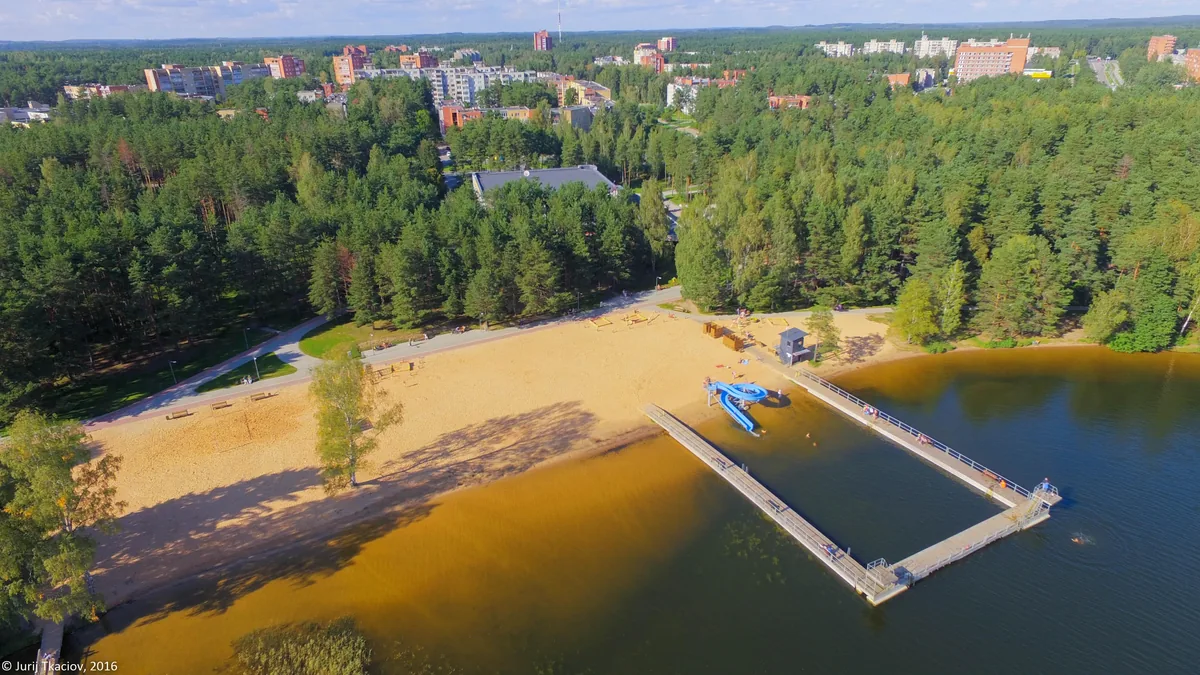
Lake Visaginas (Visagino ežeras), on the southern edge of the town, is the local recreational anchor. The lake is small - about two kilometres across - but clean, with a public beach, lifeguards in summer, and rental kayaks and paddle-boards available from June through August. A wooden boardwalk runs along part of the lakeshore and connects to a small park and cafe.
Beyond the immediate town, Visaginas sits on the eastern edge of the Aukštaitija lake belt. The much larger Lake Drūkšiai - the country's largest, shared with Belarus - is five kilometres east near the nuclear plant; access is restricted along the plant's perimeter but possible at several points. Several smaller lakes and a substantial forest cover the area to the north and west, with marked walking trails and cycling routes managed by the Visaginas municipality.
For longer outdoor trips, Aukštaitija National Park is forty-five minutes south-west; Zarasai National Park is thirty minutes north along the road to Latvia. Both are easy day trips. A small but well-maintained system of cycle paths links the town to the lake and the surrounding forest, with rental bikes available at one shop on the central boulevard.
Food and shopping
Visaginas's food scene reflects its mixed population. Russian and post-Soviet cuisine is more central here than in any other Lithuanian town: pelmeni, borscht, varenyky, plov, shashlik and various salads dominate the central restaurants. The Russian café culture - heavy bread, dense pastries, sweet tea - survives in several long-running cafés on the central boulevard.
Asian food is unusually well-represented. Two Uzbek restaurants, a Korean grill, a Vietnamese pho place and a Chinese-Russian fusion restaurant operate in the central area. The Asian community in Visaginas is small but established, originally drawn in by Soviet-era nuclear engineering placements; the food culture has stuck.
Shopping is functional rather than scenic. The central supermarket (Maxima or Iki, depending on the year) covers most needs; a separate Russian-style market on the eastern edge of the town sells fresh produce, smoked fish, Russian and Belarusian grocery imports and the kind of dried herbs and pickles that are harder to find in Vilnius supermarkets. The market is busiest on Saturday mornings.
Where to stay
Visaginas has a modest accommodation offer - about a dozen hotels and guesthouses, all clustered in the central area. The largest is the Hotel Aukštaitija, a 1980s sanatorium-style hotel with full conference facilities and large rooms; rates run €60–80 per night for a double in standard season. Two or three smaller boutique places - including a small family-run guesthouse near the cultural centre - offer a quieter alternative.
Self-catering apartments are also available through the standard booking platforms and are a reasonable option for a multi-night stay or for travellers who want to experience daily life in a Soviet-era apartment block. Several owners specifically advertise their properties as "Soviet-experience" rentals with retained period decor.
Camping and rural accommodation outside the town are limited. The closest sodybos are around Lake Drūkšiai (where access is partially restricted) and toward Zarasai to the north. For most visitors, the simplest plan is one or two nights in the central town and onward travel into Aukštaitija or Latvia rather than rural overnighting in the immediate area.
Best time to visit
Late spring and summer are the best months - May through early September. The lakeside is at its best, the festival calendar is concentrated in this window (jazz in early August, theatre in mid-September), and the weather is comfortable for walking the town's broad boulevards. Daytime temperatures sit in the high teens to mid twenties.
Autumn (September and October) is quieter but visually striking - the forest around the town turns brilliant orange and red, and the Soviet-era apartment blocks against the autumn foliage make an unusual photographic subject. Late autumn and early winter (November to early December) have the shortest, dimmest light and are not recommended for a first visit.
Winter (December to March) is dramatic. The lakes freeze; ice fishing is a local pastime; the town's public spaces feel particularly Soviet-era in heavy snow and short daylight. The annual winter festival at the cultural centre is a smaller-scale event but worth catching for visitors interested in Russian-Lithuanian post-Soviet culture. Most accommodation stays open year-round; the nuclear plant tours run year-round with advance booking.
A 1-day visit from Vilnius
The simplest visit is a day trip from Vilnius. Take the morning train (around 7:30 a.m.) from Vilnius station, arriving in Visaginas just after 9:30. Walk to the central square via the pedestrian boulevard (about fifteen minutes from the station), spend an hour at the cultural centre and the central area, and walk one of the micro-districts for the most photogenic Soviet-era street architecture.
Lunch at one of the central Russian or Uzbek restaurants - Vostok and Tashkent are both reliable. Afternoon options include a guided tour of the Ignalina nuclear plant (must be booked at least a week in advance and takes around three hours) or a quieter walk around Lake Visaginas with a stop at the Russian Orthodox cathedral. For visitors interested in the Russian-speaking community, the Russian cultural centre offers walk-in informal visits.
Return to Vilnius on the late afternoon train (around 5:30 p.m.) for an evening arrival. A two-day visit allows for both the plant tour and the lake plus a deeper exploration of the town's history; an overnight at one of the central hotels is comfortable and reasonably priced.
Practical tips
Russian and Lithuanian are both widely used in Visaginas; English is spoken by younger staff at hotels, restaurants and the tourist information centre but is not as universally available as in Vilnius. A few words of Lithuanian or Russian are noticeably appreciated. The town's linguistic situation is genuinely mixed - switching between languages mid-conversation is normal.
The nuclear plant tour requires advance booking through the Ignalina AE Visitor Centre website (at least one week ahead, longer in summer). Bring a passport - the security check at the plant gate is genuine. Photography is restricted in some parts of the plant; the tour guide will be clear about what is and is not permitted.
Mobile signal is good in the town but patchier toward the plant and the lake. Card payment is universal in restaurants and hotels; the Russian-style market on the eastern edge prefers cash. ATMs are reliable on the central boulevard.
The town has occasionally been covered negatively in Lithuanian and international media, especially around questions of loyalty and identity since 2022. On the ground, the picture is more complicated than the headlines: people are polite, cultural life is real, and views on the war in Ukraine do not fit simple labels. It is better to arrive without a fixed conclusion and look closely at the city.