The character of Nida
Nida is the southernmost Lithuanian settlement on the Curonian Spit, sitting just four kilometres from the Russian Kaliningrad border. The town has about 1,500 year-round residents and is the cultural and administrative capital of the Lithuanian half of the Spit. In summer the population swells severalfold as visitors fill the wooden-house guesthouses, the harbour-side restaurants and the sand-dune walking trails.
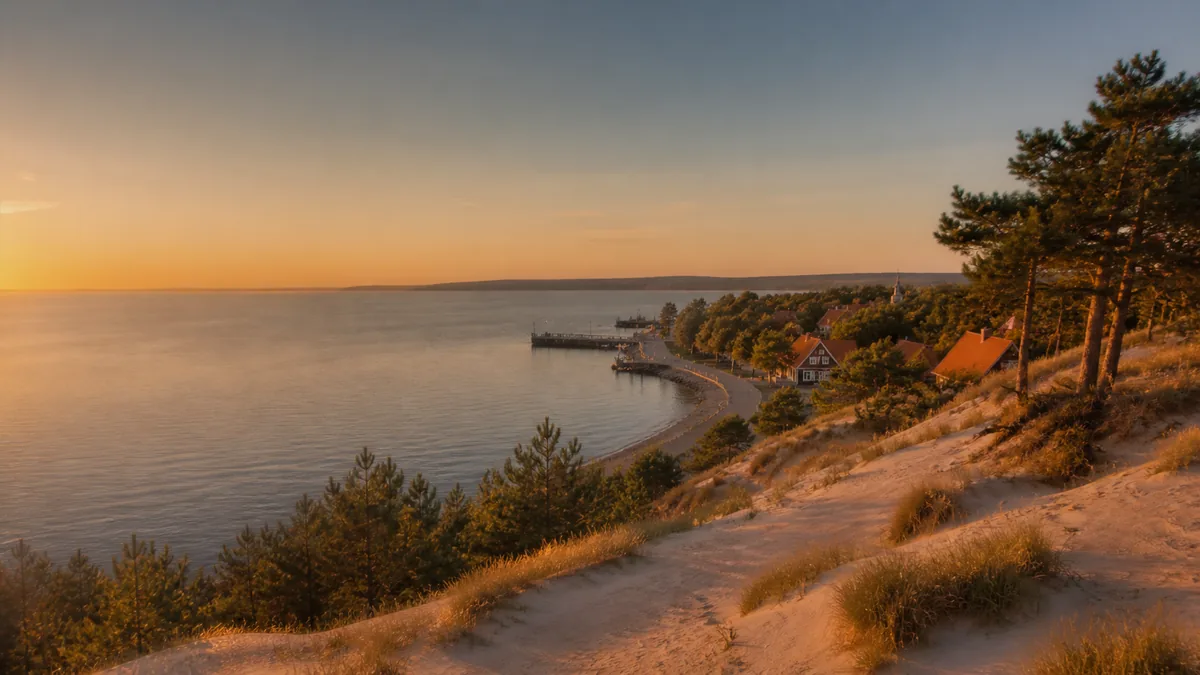
What sets Nida apart is its setting. The town sits on a narrow strip of land between the Baltic Sea on one side and the Curonian Lagoon on the other. Behind it rise the moving sand dunes - the largest in Northern Europe - which give the Spit its UNESCO World Heritage status. The wooden architecture, painted in deep reds and dark blues against the pale sand, has become one of the country's most reproduced visual signatures.
For visitors, Nida works as either a half-day stop on a Klaipėda-based itinerary or as a multi-night base for cycling, beach time and a slower experience of the wider Spit. The town's small size means almost everything is walkable; the wider Spit landscape is best explored by bicycle or, for the further northern villages, by car or local bus.
The Curonian Spit and its setting
The Curonian Spit (Kuršių nerija) is a 98-kilometre sand peninsula that runs from north of Klaipėda south to the Russian Kaliningrad enclave. The Lithuanian half is fifty-two kilometres long and reaches a maximum width of around four kilometres. The terrain is shifting sand dunes - formed over thousands of years by Baltic winds - stabilised in the eighteenth and nineteenth centuries by deliberate planted forest after the original tree cover was felled and entire villages buried under moving sand.
The Spit's designation as a UNESCO World Heritage site (since 2000) recognises both the natural landscape and the centuries of human work that has held it together. The replanted pine forest covers most of the interior; the dune ridges along both coasts are protected as core conservation zones. Walking on the active dunes is restricted to designated paths in most areas. The whole Spit is a strict-protection national park with an entry fee per vehicle.
Geographically, Nida sits at one of the narrowest points of the Spit. The Baltic beach is a five-minute walk from the lagoon-side harbour. The Parnidis Dune, just south of the town, is the only large active sand dune in the Lithuanian section that visitors can climb. The natural setting is the reason most people come.
The wooden fishermen's houses
Nida's most photographed feature is its old wooden architecture. The traditional Curonian fisherman's house is a low single-storey wooden building with characteristic deep-red walls, dark blue trim around the windows and doors, and intricate carved wooden gables that often depict horses, the regional symbol. The colour scheme was originally functional - the dark colours used pine-tar paint that was both cheap and weatherproof - but has become the visual signature of the Spit.
The Karvaičiai-style house, the standard reference, has a steep roof, a small enclosed verandah and a separate stable section. About forty original or carefully reconstructed houses survive in central Nida, mostly along the lagoon-side streets behind the harbour. The most attractive concentration is along Lotmiškio and Naglių streets, where the wooden houses are still in everyday residential or guesthouse use.
The Ethnographic Museum at Naglių 4 occupies a restored fisherman's house and provides the best introduction to traditional Spit life - the seasonal cycle of fishing, the architecture itself, the Curonian Lithuanian dialect that is now nearly extinct, and the German cultural overlay from the centuries of Prussian rule. The museum is small but unusually well-curated.
Parnidis Dune
The Parnidis Dune is the single most famous landscape in Lithuania and the focal point of any Nida visit. The dune rises about fifty-two metres above sea level and runs along the lagoon side just south of the town, a fifteen-minute walk from the central harbour. The view from the top - west to the Baltic, east across the lagoon to the Lithuanian mainland, south into the Russian Kaliningrad section - is the country's definitive panorama.
Access is strictly managed. The marked walking path follows wooden boardwalks across the protected sand to the summit; stepping off the path is not permitted and is subject to fines. The summit is open at all times and free of charge. Sunrise and sunset are dramatically different experiences and both are worth the early start or evening walk, with the latter slightly less crowded.
At the summit sits the famous Parnidis Sundial - a stone column engraved with the Sun's movement through the year, designed by sculptor Klaudijus Pūdymas in 1995 and rebuilt after a 1999 storm damaged the original. The sundial is functional in clear conditions and is the most-photographed object on the Spit after the dune itself. A small interpretive plaque at the base explains the design in three languages.
The Thomas Mann House
Thomas Mann - the German Nobel-laureate novelist - built a wooden summer house at Nida in 1929 and spent three consecutive summers there before the rise of National Socialism made return impossible. The house, on a low hill overlooking the lagoon a fifteen-minute walk south of the town centre, has been a literary museum since 1996 and is one of the most visited cultural attractions on the Spit.
The interior is small - a writing room, a sitting room, a sleeping area and a small porch - but is the most authentic literary site in Lithuania. Mann's correspondence with his publisher Samuel Fischer about the house is on display along with first editions of the novels he worked on during his Nida summers, including parts of "Joseph and His Brothers." The garden has been replanted to match the original 1930s layout.
The Mann House also operates as a working cultural centre, with regular lectures, concerts and writing residencies for invited authors. The annual Mann Cultural Festival in early summer brings German and Lithuanian writers, scholars and musicians for a week of public events. The house is open daily in season, with reduced winter hours.
The harbour and Nida marina
The Nida harbour sits at the heart of the lagoon-side town and is one of the most photogenic working ports in Lithuania. The marina hosts both fishing boats and a substantial recreational sailing fleet - yachts, smaller sail-craft, a couple of restored traditional Curonian fishing boats called kurėnai. The wider harbourside has been carefully restored with a mix of working sheds, restaurants and a paved promenade that runs north for several kilometres.
Boat trips on the lagoon are the main activity. A traditional fishing-boat replica runs scheduled lagoon excursions in summer, with onboard fish-smoking demonstrations and a stop at a nearby island. Faster motor cruises run hourly to the Russian Kaliningrad border and back; serious sailors can charter for multi-day cruises with the Klaipėda yacht club. Stand-up paddleboards and kayaks are rentable along the harbourfront.
The harbour is also the site of Nida's annual fishing festivals - particularly the late-July Sea Festival, which spreads from Klaipėda along the Spit and brings small-boat regattas, smoked-fish competitions and music to Nida's waterfront. A smaller October smelt-fishing festival is the other notable event in the local calendar.
Smoked fish and the Curonian smokehouse tradition
Smoked fish is Nida's defining food. The Curonian Lithuanian smokehouse tradition uses juniper or alder wood - different from the oak preferred in Klaipėda - producing a milder, sweeter flavour. The smoking is done in upright wooden cabinets, often visible from the harbour-side restaurants, and uses fish caught on the same day from the Baltic or the lagoon: perch, pike, zander, eel, smelt and Baltic herring.
Several smokehouses in Nida have been operating continuously since the early twentieth century. The Žvejų Užeiga and the Karvaičio Smokehouse are the two longest-established and offer on-site tastings as well as takeaway. A standard Spit smoked-fish platter - five or six varieties served with rye bread, sour cream and pickled onions - is available at most harbour restaurants and is the canonical Nida lunch.
Eel is the regional specialty. The Curonian Lagoon's eel fishery has declined significantly in recent decades, with smoked eel now sold mostly to high-end restaurants and at premium prices. Locally caught eel still appears on the most ambitious menus; substantially more comes from controlled aquaculture or imported sources. The taste of true Lagoon-caught smoked eel is a different thing entirely from the standard supermarket version.
Cycling on the Spit
Cycling is the Curonian Spit's signature outdoor activity. A continuous paved cycle path runs almost the full length of the Lithuanian Spit from the Klaipėda ferry to Nida, fifty kilometres on hard tarmac through pine forest with regular access points to both the Baltic and the lagoon sides. The path is well-marked, generally flat, and suitable for casual cyclists.
Bicycle rental is available at the ferry on the Klaipėda side, in Nida itself, and at Juodkrantė halfway. Standard hybrid bikes run €10–15 per day; e-bikes around €25. Kids' bikes, child seats and trailers are widely available. Most rental places allow one-way drop-off (rent in Nida, return at the ferry) for an additional fee.
A practical introduction is a half-day ride from Nida north to Juodkrantė for the Hill of Witches and a smoked-fish lunch. The full one-way ride from Nida to the Klaipėda ferry takes most cyclists three to five hours including rest stops. Multi-day Spit-and-Lagoon cycle tours combining the two sides via lagoon ferry to the Lithuanian mainland are run by a couple of Klaipėda-based companies.
The beaches: Baltic side and lagoon side
Nida has two distinct beaches. The Baltic beach, a five-minute walk west of the town centre, is the wider and more dramatic - a long sweep of fine white sand backed by the protected forest and dunes. Lifeguards staff the central section in July and August; informal beach areas extend several kilometres in each direction. The water is cold by Mediterranean standards but warms to comfortable temperatures by mid-July; the swell is generally moderate.
The lagoon beach, just east of the harbour, is calmer, warmer and shallower - better suited to children and to swimmers who want flat water. The lagoon's salinity is low (it's essentially brackish water cut off from the sea) and the bottom is gentle sand. Stand-up paddleboards and small sailing dinghies launch from the lagoon side throughout summer.
Both beaches are essentially undeveloped - there are no large beach bars, no rows of sun loungers, no commercial activity beyond the official lifeguard stations and a couple of seasonal cafés. The atmosphere is quiet and family-oriented. Topless sunbathing is broadly accepted on both sides; nude bathing is permitted only at a designated naturist section south of the main Baltic beach.
Where to stay
Nida's accommodation offer is concentrated in the wooden-house district and at the lagoon-front. About thirty guesthouses and small hotels operate inside the town, with capacity for perhaps 1,500 visitors at peak. Three larger hotels - including the Nida Hotel and the Jūratė resort - offer modern facilities. The most atmospheric stays are in restored fishermen's houses, often family-run with four to ten rooms.
Pricing is heavily seasonal. A standard double in a wooden-house guesthouse runs €100–200 per night in July and August, €60–110 in June or September, and €50–80 in shoulder season. The largest hotels charge somewhat more but offer additional facilities (spa, pool, restaurant). Self-catering apartments run by individual owners are sometimes available through Booking.com or Airbnb at competitive rates.
Booking ahead is essential for July and August - a three-to-four-week lead time is typical for the better wooden-house guesthouses, longer for the most popular ones. Walk-in availability is more reliable from late September through May. Cancellation policies are strict at the smaller places; check before booking if your dates are flexible.
Best time to visit
High season runs from late June to mid-August. This is when Nida is most alive - the harbour is full of boats, the smokehouses are busy, the Mann House festival is in full swing, and most of the seasonal restaurants are open. It is also when the town is busiest and most expensive; booking ahead is essential and walk-in restaurant tables can be hard to come by at peak hours.
May, June and September are quieter and arguably more rewarding. The light is at its softest, the dunes are uncrowded, the cycle path is comfortable, and migration birds are passing through the lagoon. Sea temperatures in May are still cold but daytime air temperatures are pleasant. Autumn brings the cranberry harvest in the surrounding bogs and the smelt-fishing season.
Winter is dramatic - wind, big skies, almost empty beaches. About half the guesthouses close from late October to April. Klaipėda is the only realistic year-round base on the wider region; for a Spit-focused winter visit, a one-night stay in the few open Nida guesthouses is the best option. The Christmas-period crossings can be limited if the lagoon ices over.
Getting to Nida
The Curonian Spit is reached by car ferry from Klaipėda - a continuous service that runs all day, seven days a week. The crossing itself takes only five minutes; queues at peak times can take twenty to forty additional minutes. There are two ferry routes: the New Ferry (Smiltynė's northern dock) for cars, and the Old Town Ferry (which is mostly for foot passengers and bicycles). Both arrive on the Spit at Smiltynė, where the road south to Nida begins.
From Smiltynė, the drive to Nida is fifty kilometres on a single road through the forest. The drive takes about an hour at the limit. Public buses also run several times a day in summer, taking around 75 minutes Klaipėda-to-Nida including the ferry crossing. Taxi service from Klaipėda is available but expensive.
The Spit ecological fee is collected at a barrier just past the Smiltynė ferry. The fee is per vehicle (motorcycles less, vans more) and currently runs at around €20 for a multi-day visit and €5 for a single day. Foot passengers and cyclists pass free. The fee is paid by card at the barrier and covers the entire Lithuanian Spit including all its parking, paths and beach access.
Day trip versus overnight
Nida works adequately as a day trip from Klaipėda - most visitors do exactly this - but it rewards an overnight stay. The day-trip pattern misses the early-morning empty harbour, the late-evening dune at sunset, and the quiet wooden-house streets after the bus tours have left. A two-night stay allows time for the Parnidis Dune at both sunrise and sunset, the Mann House, a half-day on the beach, and a morning cycle ride to Juodkrantė.
For visitors based in Klaipėda, the practical compromise is one full day-trip plus one overnight on a longer itinerary. The day-trip lets you see the town and Parnidis; the overnight lets you experience the Spit in its quieter moods. For visitors based in Vilnius, a Nida overnight is essentially mandatory if you want to see the place properly - a same-day round trip from Vilnius is logistically possible but exhausting.
For families with younger children, an overnight is strongly recommended. The combination of beach, harbour boats, sundial walk and shallow lagoon swimming is exactly the kind of stops that work better at the slower pace of an overnight than the rushed day-trip pattern.
Practical tips
The Spit ecological fee is collected at a barrier just past the ferry. The fee is per vehicle, paid by card at the barrier, and covers the whole Spit. There is no separate Nida town fee. The fee structure is reviewed annually; current rates are posted at the barrier and on the Spit administration website.
Parking in Nida itself is mostly paid in summer, with a pay-and-display system at the main central lots. The closest free parking is at the southern end of the town, near the Mann House. A small shuttle bus runs in peak season between the parking areas and the harbour for visitors who don't want the walk.
English is widely spoken in Nida - German and Russian also widely. The town's long history as a literary and tourist destination means the language barrier is lower here than almost anywhere else in Lithuania. A few words of Lithuanian are appreciated but rarely needed.
Cash is rarely needed; card payment is universal. ATMs are limited - one or two in central Nida - so card-based travellers should not have problems. Mobile signal is generally good throughout the town and on the cycle paths; it can drop in pockets within the deeper forest. Sunscreen, water and insect repellent are essentials in summer; the dunes are exposed and the forest paths have biting flies in still weather.