At a glance
Use Palanga for the beach-resort version of Lithuania
Palanga is the right base for a classic summer beach trip: pier walks, family hotels, restaurants, nightlife and the Amber Museum. It is not the best base for the Curonian Spit unless you have a car and enough time for the ferry.
Pick Palanga if
You want swimming, easy family hotels, evening streets and a resort atmosphere in July or August.
Use Klaipėda or Nida if
The Curonian Spit, ferries, cycling or dunes are the main reason for the coast leg.
What Palanga is
Palanga is the leading seaside resort in Lithuania, on the Baltic coast about twenty-five kilometres north of Klaipėda and just south of the Latvian border. The town has roughly sixteen thousand permanent residents but absorbs a much larger summer population - by some estimates it more than doubles in late July and August, when Lithuanian families and a steady flow of Latvian, Polish and Belarusian visitors come for the beach and the resort atmosphere.
The town's identity is essentially summer-coastal. The 470-metre wooden pier, the long sandy beach, the J. Basanavičiaus pedestrian street with its bars and restaurants, and the Tiškevičius palace and botanical park are the four anchor attractions, all within walking distance of each other. The Birutė Park to the south of the town centre and the smaller resort village of Šventoji to the north extend the town's offer.
Off-season Palanga is a different town. Most of the seasonal restaurants and beach bars close from October to April; the streets become quiet; the pier, however, stays open year-round and the off-season walks along the empty winter beach are one of the more striking experiences on the Lithuanian coast.
The wooden pier
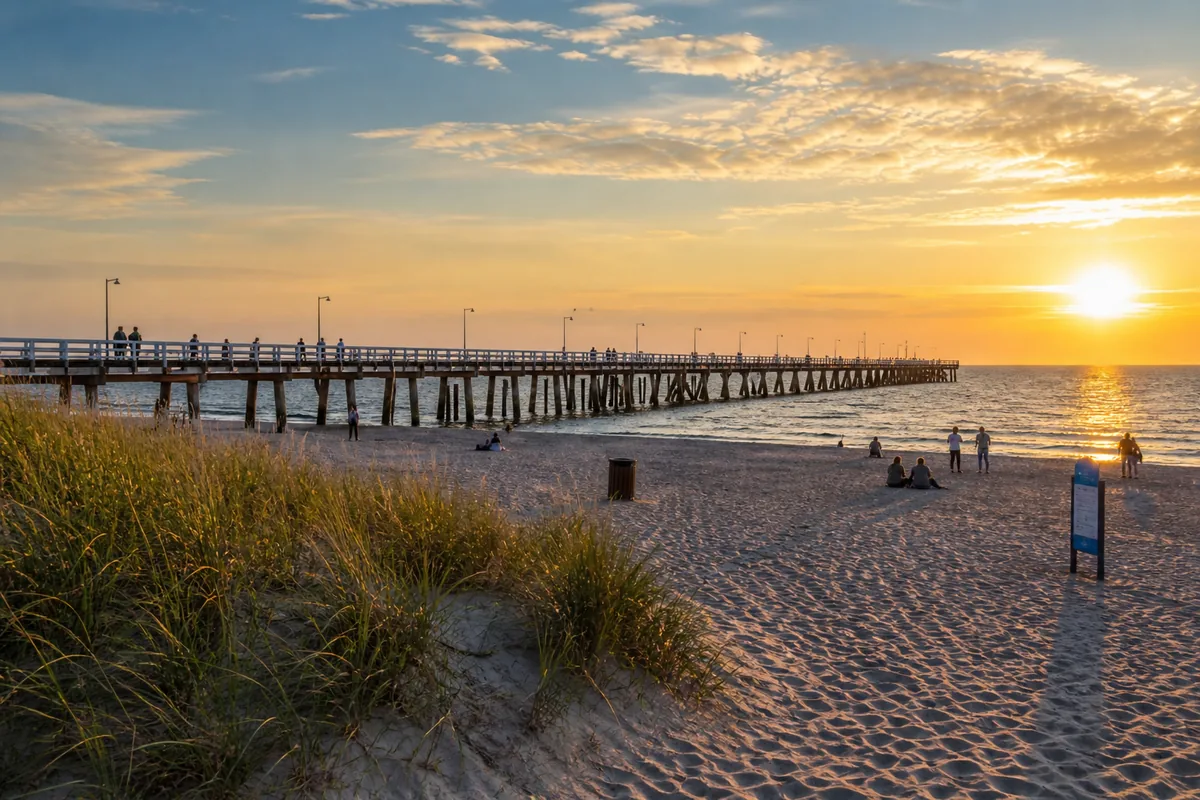
The 470-metre wooden pier is Palanga's defining symbol and one of the longest pleasure piers in northern Europe. The original pier was built in 1888, lasted only a few decades before storm damage forced repeated reconstruction, and the current incarnation dates from 1997. The pier extends straight out from the western end of J. Basanavičiaus pedestrian street into the Baltic, ending in a small viewing platform.
The pier walk is the town's evening ritual in summer - locals and visitors stroll out, watch the sunset (which over the open Baltic in midsummer happens close to ten in the evening), and walk back in the gathering dusk for dinner. In winter, the same walk is dramatic in a different register, with wind, big skies and almost no other people.
The pier is wood-decked and slightly springy underfoot. It is wheelchair-accessible for most of its length but the very end has a narrower section. There is no charge for access; the pier is open twenty-four hours.
Tiškevičius Palace and the Amber Museum
The Tiškevičius Palace sits in a large botanical park about ten minutes' walk south of the central pedestrian street. The neo-Renaissance mansion was built in 1897 for Count Feliksas Tiškevičius, who developed Palanga as a summer resort for the family. The interior has been preserved and restored over the past three decades.
The palace now houses the Palanga Amber Museum, the largest dedicated amber collection in the world. Its 28,000 pieces include the largest single piece of Baltic amber on public display anywhere - a 3.5-kilogram specimen known as "Sun Stone" - along with extensive historical jewellery, scientific specimens of inclusions (insects, plants and small animals trapped in fossilised resin), and a substantial collection of contemporary amber sculpture.
The botanical park around the palace is itself one of the most attractive public spaces in Lithuania. Designed by Édouard François André, the same French landscape architect who designed Užutrakis park near Trakai, it covers about a hundred hectares and includes the small chapel-mausoleum of the Tiškevičius family on Birutė Hill at the park's northern edge. The park is free and open year-round; the Amber Museum charges six euros and is open daily except Mondays.
The beach and the sea
Palanga's beach is a long sandy strip running for nearly twenty kilometres up the coast - from the southern Šventoji edge of the resort town up to the Latvian border at Nida (a different Nida from the one on the Curonian Spit). The central section of the beach by the pier is the busiest; quieter sections are a fifteen-minute walk in either direction.
The water is cold by Mediterranean standards but warms to comfortable swimming temperatures by mid-July, and the sea-bottom slope is gentle for a long way out. Lifeguards staff the central beach during summer; flag systems indicate swimming conditions, and high winds occasionally close the beach for swimming.
Beach culture in Palanga is decidedly Lithuanian - large beach umbrellas, families with grandparents and small children, a steady trade in smoked fish from beach vendors. Beach equipment rental (umbrellas, deck chairs, paddle boards) is available at the pier end. A nudist beach operates on a clearly signed section of the dune coast about two kilometres south.
J. Basanavičiaus street and the resort centre
J. Basanavičiaus pedestrian street is the spine of summer Palanga - a kilometre of restaurants, bars, ice-cream stalls, fairground rides, souvenir shops and street performers running from the town centre to the pier. The street is closed to cars year-round and is the town's social centre during the summer evenings.
The atmosphere is unmistakably resort-town and slightly carnival. It is not the place to come for refined dining or quiet contemplation; for those, the restaurants near the botanical park and the manor are better. For atmosphere, sound and the energy of a Baltic summer evening, the pedestrian street is unmatched in Lithuania.
Several long-established restaurants on the side streets that branch off J. Basanavičiaus do serious work with regional Baltic cuisine. The Vila Onegzia and the Žuvinė are the two most consistent. Outside the peak summer weeks, walk-in tables are available at most places.
Birutė Hill, the Birutė Chapel and Mount Naglis
Birutė Hill rises about twenty metres above the surrounding park at the northern edge of the Tiškevičius botanical park. According to medieval legend, this is where the priestess Birutė - wife of Grand Duke Kęstutis and mother of Vytautas the Great - tended the sacred fire of the pre-Christian Baltic religion. The small neo-Gothic chapel at the top, built in 1869, marks the spot.
The hill is one of the most important sites of pre-Christian Baltic religious memory in Lithuania, and Lithuanian neo-pagan groups still hold occasional summer-solstice ceremonies here. For most visitors it is simply a quiet wooded climb with a small chapel at the top - a five-minute walk from the palace and worth the detour.
Mount Naglis, a few hundred metres further north, is a small dune that holds a similar place in Baltic mythological memory and offers a view across the beach. Both sites are free and open year-round. Combined with the palace and the botanical park, they make a very full half-day visit.
Šventoji and the northern coast
Šventoji, just north of Palanga and now administratively part of the same municipality, is a smaller and quieter alternative resort. It has its own beach, a smaller pedestrian zone and a cluster of family-friendly accommodation that tends to be cheaper than central Palanga. The atmosphere is more Lithuanian-domestic than tourist; many Lithuanian families keep summer cottages here.
For visitors based in Palanga, Šventoji is a useful escape from the busiest July and August weekends. The cycle path between the two centres runs along the dunes for about four kilometres and is one of the better short cycle rides on the coast.
Further north, the small village of Nemirseta marks the boundary of the urbanised resort coast. North of there, the coast becomes wilder and quieter - a string of small villages and farmsteads continues to the Latvian border at Būtingė. This stretch is reachable by bicycle and is the off-season Palanga traveller's natural extension.
Cuisine and dining
Palanga's food scene is organised around two poles. The first is the casual high-volume side - pedestrian-street restaurants, beach bars, ice-cream stalls, smoked-fish kiosks. Quality is variable but the prices are reasonable and the atmosphere is the point.
The second pole is more polished - restaurants around the botanical park, in the side streets off the pedestrian zone, and at the larger hotels. Smoked Baltic fish, local lamb, summer berries and Lithuanian wine (yes, there is some) are the standout local items. A handful of restaurants do serious work with regional traditions.
For sweet things, Palanga is famous in Lithuania for kibinai (the Karaim pastries also associated with Trakai) and for ice cream. Several long-established ice-cream parlours on the pedestrian street have become summer institutions. Some make their own; others sell well-known Lithuanian brands.
Where to stay in Palanga
Palanga has the largest seasonal hotel capacity in Lithuania - several hundred hotels and guesthouses operate from May to September, with about a third staying open year-round. Booking ahead is essential in late July and August; weekend prices in those weeks can be triple shoulder-season rates.
The largest year-round hotels are the Palanga Spa Design and the Vanagupė Hotel, both with full spa facilities and conference space. Several mid-range three-stars cluster near the pedestrian street. For more atmosphere and lower prices, smaller boutique hotels and B&Bs in the residential streets behind the central area are worth the slight extra walk.
Self-catering apartments and short-let cottages are the most popular option for Lithuanian families and dominate the local accommodation market. Šventoji has a particularly strong supply of these. A dedicated accommodation guide for Palanga is in development.
Getting to and around Palanga
Palanga has its own international airport with summer connections to a small set of European cities - Copenhagen, Riga, Frankfurt, Berlin and a handful of seasonal routes. For most international visitors the route runs via Vilnius (an hour by domestic flight) or via overland transit from Klaipėda.
From Vilnius the drive is about three and a half hours via the A1 motorway; the road is good and the trip is straightforward. Buses from Vilnius bus station run hourly; the journey is just over four hours and tickets cost ten to twenty euros. Trains do not run directly to Palanga; the closest railway station is Klaipėda, with a regular bus connection from there.
The town centre is compact and walkable. Bicycles can be hired at numerous shops near the pier; the cycle path along the coast runs for fifteen kilometres in each direction. Within the town, the main getting-around method is on foot, with occasional taxis available from the central square.
Best time to visit
The classic Palanga visit is in July and August. This is when the beach culture is in full swing, the pedestrian street is at its busiest and the atmosphere is the resort-town's defining character. Booking accommodation two months ahead is recommended; spontaneous summer trips often end up in Šventoji or in inland farmstays for that reason.
June and September are quieter and arguably more pleasant. Sea temperatures are still cool but the air is warm enough for beach time, the pedestrian street works without the crowds, and most attractions are still open. The Klaipėda Sea Festival in late July fills both Klaipėda and Palanga with extra visitors; check the festival dates if you want to avoid them.
Off-season Palanga is dramatic and quiet. Many seasonal businesses close from October, but the year-round hotels stay open at substantially reduced rates, the pier is at its most atmospheric, and the Amber Museum is a strong indoor attraction. Christmas and New Year bring a smaller resort version of the summer crowds, with several spa hotels running winter-break packages.
Practical tips
Parking in central Palanga is paid in summer and free in winter; there are several large car parks within walking distance of the pier. Do not park in residential streets without checking the signage - fines are issued reliably.
The Amber Museum is a strong rainy-day option. Combined with the pier (still rewarding in mild rain) and a meal in one of the restaurants near the palace, it makes a good full afternoon.
English is widely spoken in Palanga, particularly by hotel and restaurant staff. Russian is also common. German is more useful here than elsewhere in Lithuania given historical visitor patterns. Card payment is universal except at a few beach kiosks; cash is rarely needed.
Mosquitoes can be intense in the wooded sections of the botanical park in the early evening, particularly in June and early July. Repellent helps. The beach and pier areas are wind-swept enough that mosquitoes are not generally an issue.