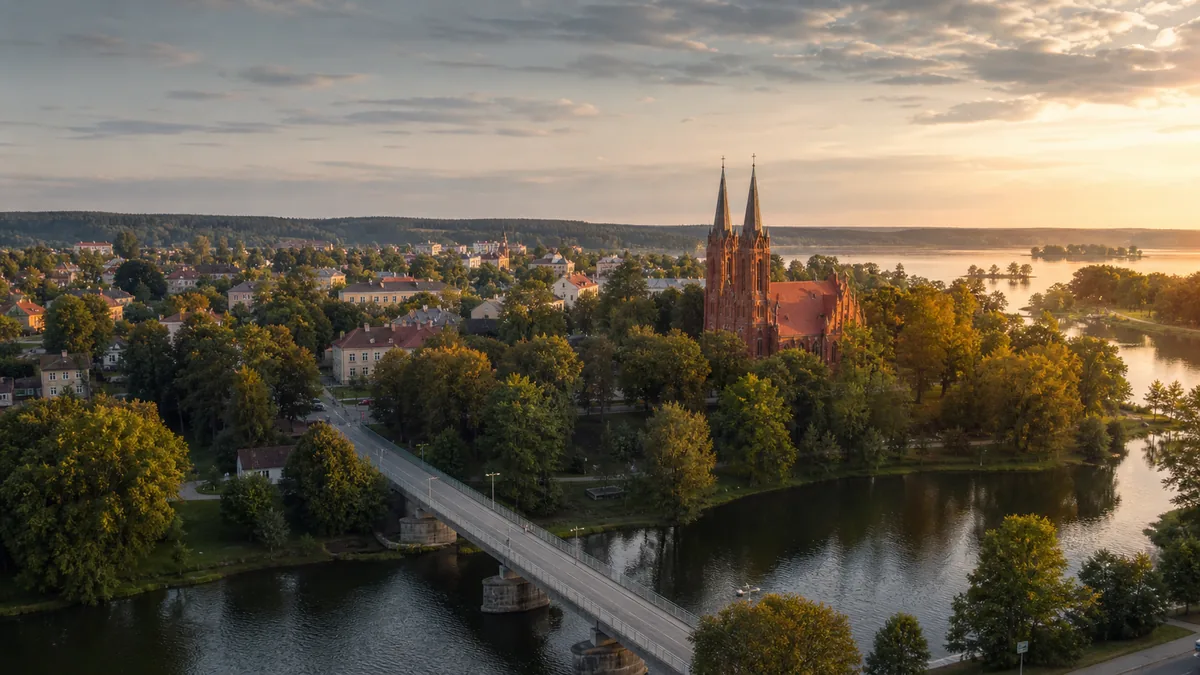
The character of Anykščiai
Anykščiai is a town of about ten thousand people on the Šventoji river, ninety minutes north-west of Vilnius and an hour and a half north-east of Kaunas. It is the cultural anchor of the western half of the Aukštaitija region, with a literary heritage that Lithuanians take seriously, a basilica that dominates the skyline, and a working narrow-gauge railway that has become an unexpected tourist hit. The setting is pretty rather than dramatic - wooded river valley, low rolling farmland, and pine forest on the surrounding ridges.
For visitors, Anykščiai works as either a long day-trip from Vilnius or a two-night stop on a wider route through eastern Lithuania. Most of the headline attractions are within a fifteen-minute drive of the town centre; the rest of the surrounding district has another half-dozen serious cultural sites worth a slow morning each. The town itself has been carefully maintained - reconstructed historic centre, well-marked walking routes, signage in three languages - and is one of the most travel-ready small towns in Lithuania.
The Lithuanian-language name is pronounced approximately AN-iksh-cheh, with the stress on the first syllable. The river, the Šventoji (literally "the holy one"), runs through the town centre and is the geographical spine of the wider district.
Antanas Baranauskas and the literary heritage
Anykščiai is the birthplace and lifelong home of Antanas Baranauskas (1835-1902), the bishop, mathematician and poet whose long poem "Anykščių šilelis" ("The Forest of Anykščiai") is one of the foundational texts in modern Lithuanian literature. The poem - written in 1858-1859 when Baranauskas was a seminarian - is a lament for the destruction of the local pine forest and is studied by every Lithuanian schoolchild.
The Baranauskas Memorial House Museum, on the eastern side of the town centre, preserves the modest wooden cottage where the poet was born and grew up. The museum is small but unusually moving - original furniture, period dress, manuscript pages, and a careful exhibition that places the poem in its political context (the Russian Empire was actively suppressing the Lithuanian language at the time of writing).
The wider Anykščiai literary tradition continues with the writers Antanas Vienuolis (1882-1957) and Jonas Biliūnas (1879-1907), both born in the surrounding villages. The Vienuolis house museum is in central Anykščiai; the Biliūnas memorial - a small stone obelisk on a hill - sits about ten kilometres outside the town and is the burial place specified in the writer's most famous short story.
The basilica of St. Matthias
The Anykščiai basilica - the Church of St. Matthias the Apostle - is the tallest church in Lithuania at seventy-nine metres to the tip of its main spire. The current neo-Gothic building, completed in 1909, replaced an older wooden church and is built of red brick with limestone facing on the western front. The twin towers are the town's defining skyline feature and are visible from the surrounding ridges several kilometres away.
The interior is atmospheric rather than spectacular - high vaulted nave, period stained glass, several substantial side altars and a large central crucifix. A spiral stair inside the southern tower is open to visitors during summer months for a small fee; the climb is around thirty metres and gives a panoramic view across the town and the river valley below.
The basilica has hourly opening times that vary with the church calendar; the tower and the visitor sections are open daily from 10:00 to 17:00 from May to September and on weekends only the rest of the year. A small information desk at the western entrance has English-language leaflets.
The narrow-gauge railway
The Anykščiai narrow-gauge railway - Aukštaitijos siaurukas - is one of the most distinctive cultural attractions in northern Lithuania. The 750-millimetre track was built between 1891 and 1899 as part of an imperial Russian network connecting the rural interior to the wider broad-gauge railway. The Anykščiai-Rubikiai-Panevėžys line was the most heavily used and operated commercial freight services until 2001.
The surviving section between Anykščiai and Rubikiai (a small lakeside village fifteen kilometres south) is now a heritage operation. Steam locomotives run on summer weekends and selected Saturdays through the year; diesel railcars run a more regular schedule from May to September. The journey takes around forty minutes one-way and includes several photo-stops at restored station buildings and a slow run through pine forest along the lake shore.
Tickets are €10-15 one-way for adults depending on traction, with combined return-and-Rubikiai-lunch packages available through the operator's website. The Anykščiai station building - restored to its 1899 condition - is a small museum with rolling stock displays and is open daily.
The treetop walk (Lajų takas)
The Anykščiai treetop walk - Lajų takas - is the most visited single attraction in eastern Lithuania, opened in 2015 in the surrounding pine forest about two kilometres from the town centre. The 300-metre wooden boardwalk runs through the canopy at heights of up to twenty-one metres, ending at a 34-metre observation tower that gives a 360-degree view across the Šventoji river valley.
The walk has been carefully built for accessibility - a gradual ramp rather than stairs makes it suitable for wheelchairs and pushchairs throughout the boardwalk section. The observation tower at the end has an internal lift as well as a spiral staircase. Information boards along the route, in Lithuanian/English/Russian, explain the surrounding forest ecology and the historical context of Baranauskas's poem.
The site includes a visitor centre with a café, a small museum on local forest ecology, and an outdoor children's play area. Tickets are around €10 for adults and €6 for children. The site is open all year, weather permitting; the boardwalk is illuminated for evening visits during summer. Parking is free and adequate.
The Niagara of Lithuania and the Horse Museum
The "Niagara of Lithuania" - Šventosios sinklina - is a small waterfall on a tributary of the Šventoji river just outside the town. The fall is no more than four metres high but is set in a particularly attractive forested gorge with marked walking paths and a wooden viewing platform. The site is free, parking is informal but adequate, and the walk in from the road is around five minutes through old pine forest.
Five kilometres west, in the village of Niūronys, the Horse Museum (Arklio muziejus) is one of the more unusual museums in the country. The institution tells the story of the Žemaitukas - the small native Lithuanian horse - alongside a substantial collection of carriages, harnesses, agricultural equipment and folk art on equine themes. Riding is offered on summer afternoons; carriage rides through the surrounding countryside can be booked in advance.
The Horse Museum complex includes a small ethnographic farm, with traditional buildings preserved or reconstructed, and a working blacksmith demonstration on Saturdays in summer. The on-site café serves a serious traditional Lithuanian lunch. Entry is around €5 for the museum complex; riding and carriage rides are charged separately.
Anykščių Vynas and the wine cellars
Anykščių Vynas, established in 1926, is one of the oldest fermented-beverage producers in Lithuania and the country's only commercial wine producer of any scale. The company makes fruit wines - apple, blackcurrant, rowan, cherry - rather than grape wines, and has expanded into mead, fermented honey-based liqueurs, and a range of bottled cocktails.
The visitor experience at the company's Anykščiai facility is straightforward and worthwhile: a guided tour through the production buildings, a short film on the company's history, and a tasting of seven or eight house products. Tours run hourly during the day from May to October and on weekends from November to April. Tickets are around €15 per person, including the tasting; pre-booking is recommended in summer.
The Anykščių Vynas brand is sold across Lithuania in supermarkets and specialist shops; the most distinctive products - the rowan-berry wine in particular - are not available outside the country. The company shop on-site has the full range and runs occasional limited-edition releases for visitors.
The Šventoji river and outdoor activities
The Šventoji is one of the most popular canoeing rivers in Lithuania, running for 246 kilometres from the small village of Pavajuonis on the Latvian border down through Aukštaitija to its confluence with the Neris just north of Jonava. The Anykščiai stretch is the most accessible, with several outfitters in the town offering half-day, full-day and multi-day paddle trips with shuttle service.
The river is gentle - a few short rapids in the upper reaches but mostly flat-water paddling - and is suitable for beginners and families. Multi-day routes with overnight bivouac at established camp sites can run from three to six days, with the longer versions starting upstream and finishing at Anykščiai. Pre-booked rentals with delivery and pickup at the start and end points are the standard arrangement.
Beyond the river, the surrounding pine forest has marked walking and cycling routes. The Liudiškiai hill-fort, on a wooded ridge five kilometres south of the town, is the most attractive easy walk - about two kilometres each way through old pine forest, with a small archaeological site at the summit and a viewing platform looking back toward the basilica.
The Puntukas stone
The Puntukas stone is the second-largest erratic boulder in Lithuania - a single granite block left behind by the retreating glacier some twenty thousand years ago. It sits in pine forest seven kilometres south of the town, weighs around 265 tonnes, and rises to about six and a half metres above ground level. The boulder is one of the most photographed natural features in the country.
In 1943, during the Nazi occupation, the Lithuanian sculptor Bronius Pundzius carved relief portraits of the aviators Steponas Darius and Stasys Girėnas into the southern face of the stone. Darius and Girėnas had crossed the Atlantic in 1933 in a small aeroplane and crashed in eastern Germany, becoming national heroes. The carving is considered a quietly defiant act of cultural commemoration during the occupation.
The site is free, accessible by paved road from the A1 motorway turn-off, and signposted in three languages. A wooden walkway and viewing platforms give easy access from the small parking area. The stone has informally become a meeting point for cycle tourists and a stopping point for school field trips.
Food and dining
Anykščiai has a reasonable but not exceptional restaurant scene. The most established places are concentrated in the central pedestrian area near the basilica and along the riverside park: a couple of mid-priced restaurants serving updated traditional Lithuanian cooking, a casual smoked-fish place near the railway station, and several casual cafés.
The most distinctive food experience in the area is the tasting at Anykščių Vynas (described above) and the traditional lunch at the Niūronys Horse Museum café - both offer authentic regional cooking that has not been polished for tourist tastes. The Saturday market in the central square has small-producer stalls with local cheeses, smoked meats, honey and bread; it runs through the morning and into the early afternoon.
For a proper restaurant dinner, the recommended option is the restaurant at the Hotel Avilys in the central area, which has a small menu of more ambitious regional dishes and a reasonably broad wine list. Reservations are recommended for weekend evenings in summer.
Where to stay
Anykščiai has about a dozen central accommodation options, ranging from boutique hotels in restored historic buildings to small B&Bs in modern conversions. The most established central hotels are the Hotel Avilys and the Šventojo Mato Avilys, both within easy walking distance of the basilica and the river park. Rates run €70-110 per night for a double in summer.
Self-catering cottages - sodybos - are widely available in the surrounding countryside, especially along the river upstream of the town. The Sodybos.lt booking site has the most comprehensive listings; rates run €60-90 per night for a small cottage sleeping four. Many cottages include sauna access and small private gardens.
For visitors prioritising the treetop walk and the railway, two newer guesthouses on the access road to Lajų takas are convenient. Camping is available at one designated site on the river two kilometres south of the town.
Getting there and around
By car, Anykščiai is reached on the A6 motorway from Vilnius (110 kilometres, around ninety minutes) or via secondary roads from Kaunas (115 kilometres, around an hour and a half). Road conditions are good throughout. The A6 has full services at regular intervals.
Buses run between Vilnius and Anykščiai roughly hourly during the day, with the journey taking about two hours. Single tickets are around €8. From Kaunas, services are less frequent but still adequate at three or four buses a day. The bus station is in the central area, walking distance from the basilica.
There is no passenger railway connection to Anykščiai - the surviving narrow-gauge line is heritage-only and does not connect to the wider Lithuanian rail network. Within the town and the immediate district, walking is the easiest mode for the central attractions; a car is essential for the Horse Museum, Puntukas stone, and outlying villages.
Best time to visit
Late spring and summer - May through August - are the best months for a first visit. The treetop walk, the steam railway, the wineries and the river outfitters are all running at full schedule; the basilica tower is open; weather is reliably warm. The summer cultural festivals - particularly the Anykščiai Music Festival in late July - are major events on the wider Lithuanian calendar.
September is photographically the best month, with autumn colour in the surrounding forests and quieter conditions at the headline attractions. October through April is the off-season; the treetop walk and Vynas tours stay open with reduced hours, but the steam railway runs only on selected weekends and several smaller museums close from November to early March.
A particularly worthwhile annual event is the Užgavėnės (Shrove Tuesday) celebration in February, which preserves more traditional folk elements than the urban version and is marked at the Niūronys ethnographic museum with masked figures, traditional foods and a community bonfire.
Practical tips
Cash is rarely needed except at small market stalls and a few rural sites. ATMs are reliable in the central area; cards are accepted at hotels, restaurants and the main attractions.
English is reasonably well spoken at the main attractions and central hotels but less reliable at rural sites and smaller restaurants. Younger staff generally manage; older shopkeepers and farm hosts may not. Russian remains useful with older residents; basic Lithuanian phrases are visibly appreciated.
Mobile signal is consistent across the town and surrounding district. EV charging is available at one fast charger in the central area and at the Hotel Avilys; for a longer onward route, charge before leaving for the deeper Aukštaitija forest regions.
The basilica, the treetop walk and the railway can each take a half-day in summer due to crowds and ticket queues. A two-night stay covers them comfortably; a single day-trip from Vilnius is workable but tight.