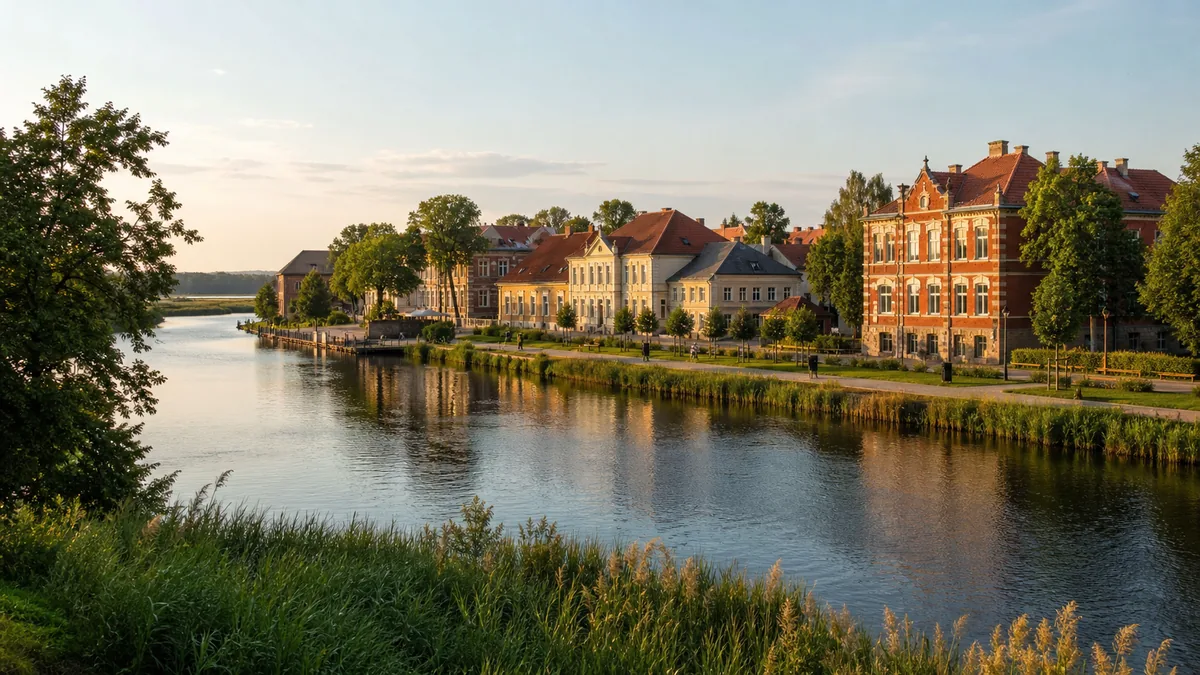
The character of Šilutė
Šilutė is a town of about 16,000 in the Mažoji Lietuva region - the historically Prussian-Lithuanian coastal lowland that became part of modern Lithuania in 1923. It sits sixty kilometres south of Klaipėda, ten kilometres inland from the Curonian Lagoon, and at the entrance to the Nemunas Delta. The setting is flat, low and watery: drainage canals, willow-lined dykes, and the slow channels of the largest river system in the Baltic states fanning out to the lagoon.
For visitors, Šilutė is best understood as a gateway rather than a destination. The town itself has two or three good museums and a substantial Lutheran-heritage centre, but the main reasons to come are the surrounding delta - Rusnė island, the Ventė bird-ringing station, the cormorant colonies at Juodkrantė just over the lagoon - and the layered cultural history of the wider region. A two-night stop is enough for most visitors to cover the headlines; a longer base works well for birdwatchers and slow travellers.
The Lithuanian-language name is pronounced approximately SHEE-loo-teh. Until 1923 the town was known as Heydekrug under German administration, and many older buildings still carry their original Prussian-era plans and details.
The Hugo Šojus Manor and Šilutė Museum
The Hugo Šojus Manor - a substantial late-nineteenth-century country house in the central area - is the cultural anchor of the town. Hugo Šojus (Scheu) was a German-Lithuanian landowner, philanthropist and folklorist who collected one of the most important pre-war archives of Lithuanian peasant culture before his death in 1937. The manor and its surrounding park were donated by his family to become a museum.
The Šilutė Museum, housed in the manor, has permanent exhibitions on the wider history of Mažoji Lietuva: the seventeenth-century settlement of the region by Lutheran Lithuanians, the German imperial era, the brief 1923-1939 period as part of Lithuania, the Soviet displacement of the original population, and the rebuilding of the region's cultural memory since 1991. The exhibitions are well-curated, with English-language labels throughout.
The manor park has been restored and includes an open-air collection of traditional Mažoji Lietuva agricultural buildings reassembled from elsewhere in the region. Entry to the museum is around €5 for adults; the park is free. The museum is open Tuesday through Sunday year-round.
The Lutheran church and religious heritage
The Šilutė Lutheran Church - built in the 1700s in the local hall-church style and substantially rebuilt in the late nineteenth century - is the largest surviving Lutheran building in modern Lithuania and the spiritual centre of the wider Mažoji Lietuva community. The church is unusually tall, with an octagonal central steeple, and dominates the town centre from several streets away.
The interior is plain in the Lutheran tradition - whitewashed walls, simple wooden pews, no stained glass - but holds a substantial pipe organ, a carved wooden pulpit, and a series of memorial plaques to pre-war community members. The church holds Sunday services in Lithuanian and German alternately and is open to respectful visitors during weekdays.
A small Reformed (Calvinist) congregation also operates in the town, in a smaller building near the manor park. Together with the Catholic parish, the surviving Russian Orthodox community and a small Old Believer prayer house, Šilutė retains more religious-community diversity per capita than almost any other small Lithuanian town.
The Macikai memorial site
Six kilometres south of Šilutė, the Macikai memorial complex is one of the most haunting cultural sites in Lithuania. The location was used in succession as a German prisoner-of-war camp (1941-1944, primarily for Soviet POWs), then as a Soviet labour camp (1945-1955, primarily for Lithuanian, Latvian and German political prisoners). It is one of the very few sites in Europe that operated under both Nazi and Soviet repressive regimes.
The site was opened as a museum in 1995 and runs as a branch of the Šilutė Museum. The exhibition is small but unusually careful - original buildings preserved where possible, archaeological work on the cemetery, oral histories from survivors of both periods, and detailed information panels in Lithuanian, English, German and Russian. The cemetery has been carefully marked and includes named memorials for several thousand victims.
The site is open Tuesday through Sunday from May to October, weekends only the rest of the year. Entry is free. The complex is somber and heavy; it merits a full hour and is not appropriate for very young children.
The Nemunas Delta
The Nemunas Delta - Nemuno delta - is the country's most important wetland and a Ramsar-protected site of international significance. The delta covers about 350 square kilometres at the river's mouth, where the Nemunas breaks into seven major channels and dozens of smaller branches before emptying into the Curonian Lagoon. The wetland supports one of the largest bird migration routes in northern Europe.
The Nemunas Delta Regional Park, established in 1992, manages the protected area and runs a visitor centre at Rusnė. The park's offering is straightforward: a visitor centre with multilingual displays on delta ecology, marked walking and cycling routes through the embanked wetlands, and several wooden viewing towers at strategic points. Boat hire is available from Rusnė and from a couple of small operators in Šilutė itself.
The most accessible visitor experience is a half-day boat trip from Rusnė through the delta channels - these are run by several operators in summer, take around three hours, and pass through the most photogenic parts of the wetland with a good chance of seeing white-tailed eagles, sea eagles, and several heron and stork species.
Rusnė Island
Rusnė is the only inhabited river-island in Lithuania, sitting at the heart of the Nemunas Delta where two of the river's main channels diverge. The island has about two thousand permanent residents and is connected to the mainland by a single road bridge that is occasionally closed during spring flooding. The atmosphere is genuinely unusual - a working fishing community, a small Catholic parish church, several restored fishermen's cottages, and the surrounding water on every side.
The Rusnė Information Centre is the main starting point for visitors and runs the regional park's permanent exhibition. The island has two small restaurants (both serving local smoked fish), a Saturday market, and a single guesthouse with about a dozen rooms. The Pakalnės nature trail - a one-kilometre boardwalk through riverside reed-bed - starts a hundred metres from the visitor centre.
Spring flooding regularly cuts off the island for a few weeks each year, typically in late March or April. During these periods access is by special ferry only; check the regional park website before planning a visit in this window. The flooding itself is part of the local rhythm and is celebrated rather than fought - surrounding fields are deliberately flooded to enrich the soil.
Ventė Cape and the bird-ringing station
Ventė Cape (Ventės ragas) is the headland on the eastern side of the Curonian Lagoon, twenty kilometres west of Šilutė. The cape is one of the most important migration corridors in northern Europe - funnelling birds southward in autumn between the Baltic and the inland flyway - and has been the site of Tadeusz Ivanauskas's ornithological station since 1929. The station claims to be the longest continuously operating bird-ringing operation in continental Europe.
The visitor centre at the cape is small but unusually engaging. The permanent exhibition covers the history of bird ringing, the methodology used at the station (large funnel-style traps that have been a model for ringing operations worldwide), and the species most commonly tracked. Multilingual displays are available in Lithuanian, English, Russian and German. A wooden lighthouse from 1863 stands near the visitor centre.
The autumn migration period - late August through October - is the best time to visit, when ringing operations are at their busiest and the daily catch can run into the thousands of birds. Visitors are welcome to watch the ringing process; respectful behaviour around the trapping nets is essential. Spring migration is quieter but still visible. The site is open daily; entry is around €4.
The smaller villages and fishermen's communities
The wider district around Šilutė includes several small fishing villages whose original character has been carefully preserved. Mingė - sometimes called the "Lithuanian Venice" - is a single-street village where every house faces a canal rather than a road, and where boats are the traditional means of transport. The setting is genuinely unusual; the village has a couple of small guesthouses and a seasonal café.
Skirvytė and Šilininkai, both on the lagoon shore, are working fishing villages with small smokehouses and seasonal restaurants serving the day's catch. Uostadvaris, on the Atmata channel, has a restored lighthouse from 1876 that is open to visitors and gives a panoramic view across the delta to the open lagoon.
Together with Rusnė, these villages form a loose network of small destinations connected by a paved cycle route through the embanked wetlands. The route is gentle, family-friendly and well-signposted; cycle hire is available at Rusnė and Uostadvaris.
Food: smoked fish and Mažoji Lietuva traditions
Šilutė and the surrounding delta have the most distinctive food culture in Lithuania. Smoked fish - primarily eel, perch, zander, herring and bream - is the regional centrepiece. The main fishing-village smokehouses operate on traditional wood-fired smoking using alder and juniper, and most are open as small retail operations through the day during summer.
The cooking traditions of Mažoji Lietuva include several Lutheran-influenced dishes that are rarer elsewhere in the country: plokštainis (a flat, dense baked-potato dish), kuršiškas alus (a regional beer style still produced in small quantities), and several dumpling and pancake variants showing strong East Prussian influence. A handful of restaurants in Šilutė and Rusnė work consciously with this heritage.
For a quick visitor introduction, the Saturday market in central Šilutė sells smoked fish, cheese, honey and bread from regional producers; the seasonal restaurant at Mingė serves a regional tasting menu by reservation; and the on-site café at the Šilutė Museum offers traditional Lithuanian-Lutheran kitchen dishes during summer.
Where to stay
Šilutė has three full-service hotels in or near the central area, all mid-range business-style operations. The Hotel Deims and the Hotel Pamarys are the most central and well-reviewed; rates run €60-90 per night for a double in summer. A handful of smaller B&Bs and guesthouses cluster in the streets around the manor park.
For a more atmospheric stay, several restored fishermen's houses in Rusnė, Mingė and Uostadvaris operate as small guesthouses. These typically have two to four rooms, charge €70-100 per night, and include a substantial breakfast featuring local smoked fish. The Sodybos.lt booking site has the most comprehensive listings.
Camping is available at one designated site near Rusnė and at several informal but tolerated locations along the cycle routes through the embanked delta. Wild camping in the regional park itself is firmly prohibited; respect the marked boundaries.
Getting there and around
By car, Šilutė is reached from Klaipėda on a paved 60-kilometre route along the lagoon shore, taking about an hour. From Vilnius the drive is around four hours via Kaunas and the A1 motorway. From Kaliningrad the route is technically possible (the border is less than fifty kilometres from Šilutė) but functionally closed since 2022 for general traffic.
Buses run between Klaipėda and Šilutė roughly every two hours during the day, with the journey taking about ninety minutes. Direct services from Vilnius and Kaunas are less frequent - three or four a day - and are operated by a single regional company. Within the wider district, buses to Rusnė and a few other delta villages run two or three times a day.
A car or rental bicycle is essential for serious exploration of the delta. The cycle network is well-developed and the terrain is flat - multi-day rides combining Šilutė, Rusnė, Mingė, Uostadvaris and Ventė are popular among Lithuanian cyclists in summer. Bike hire is available in Šilutė and Rusnė.
Best time to visit
Late spring and autumn are the best windows for a deeper visit, particularly for birdwatchers. The autumn migration through Ventė Cape - late August into October - is the headline natural event and brings serious numbers of birds and dedicated ornithologists. Spring migration (March-April) is quieter but still impressive, especially for waterbirds and waders.
Summer - June through August - is the most reliable for general visiting. Boat trips, smokehouses, restaurants and accommodation are all running at full schedule. Daytime temperatures sit in the high teens to low twenties; the wetland mosquitoes are present but manageable with repellent.
Winter is dramatic - frozen channels, big skies, wind off the lagoon - but most visitor services close. The ringing station is closed; many guesthouses operate at reduced hours; the Macikai site is open weekends only. For visitors comfortable with cold weather and a quieter experience, the off-season has its own appeal.
Practical tips
Insect repellent is essential from late May through September. The wetland environment supports a substantial mosquito population, which is most intense in the embanked sections of the delta. Long sleeves and trousers help.
Cash is rarely needed except at smaller market stalls and a few rural smokehouses. ATMs are reliable in central Šilutė. Cards are accepted at hotels, restaurants and the regional park visitor centres. EV charging is available at one fast charger in central Šilutė; the wider delta is not currently well-served.
English is reasonably well spoken in central Šilutė - the town's tourist focus on bird-watchers and German visitors has pushed up multilingual capacity. Russian remains useful with older residents. German is more common here than elsewhere in Lithuania, particularly with the older Lutheran-heritage community.
The Macikai site is sober and emotionally heavy. The Šilutė Museum staff can suggest the right order of visits if you're combining it with the manor exhibition; the standard sequence is manor first, Macikai later in the day, with a meaningful pause between.