At a glance
What Druskininkai is
Druskininkai is the leading spa town in Lithuania and one of the better-known wellness destinations in the wider Baltic region. The town has about twelve thousand permanent residents but absorbs a much larger seasonal floating population - visitors from Lithuania, Belarus, Poland, Latvia and increasingly Germany come for multi-day stays focused on mineral-water therapy, sauna culture, indoor swimming and, in winter, the country's only year-round indoor ski slope.
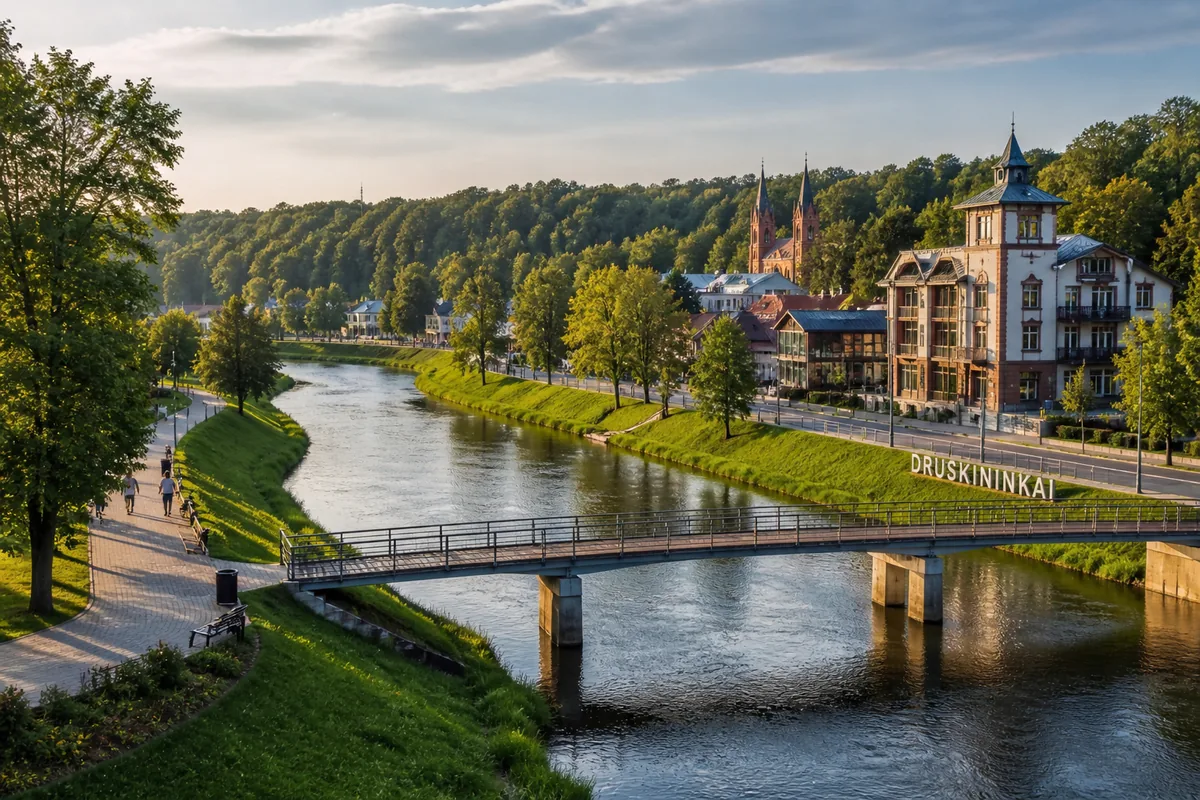
The town sits on the western edge of the Dzūkija ethnographic region, on a high bank above the Nemunas river, surrounded by pine forest. The river forms the southern boundary of the country here - Belarus is on the opposite bank, and the border post just south of the town is closed to general traffic. The mineral springs that gave Druskininkai its name (from the Lithuanian "druska", meaning salt) have been used therapeutically since at least the early nineteenth century.
Druskininkai is unusual in Lithuania for having a year-round visitor economy. Most of the country's tourist destinations go quiet from October to April; Druskininkai stays busy through every season. That makes it both the most reliable accommodation option in winter and the most consistently booked-up town for any given weekend.
Spa heritage and the mineral waters
Druskininkai's mineral-water tradition goes back to 1794, when Catholic priest Stanislovas Vendziagolskis first identified the local springs as therapeutically useful. The first formal spa opened in 1838 under the patronage of Tsar Nicholas I, who saw the town as a useful counterpart to the better-known German spas. Through the late nineteenth and early twentieth centuries Druskininkai became a fashionable resort attended by Polish, Russian and Lithuanian elites; the writer Antoni Czechow and the painter M. K. Čiurlionis both spent time here.
The Soviet period turned Druskininkai into a sanatorium town, with massive state-funded resorts built around the existing springs. Many of those buildings have been redeveloped since the 1990s into modern spa-hotel complexes. The largest are Eglė (the original Soviet-era complex, much expanded), Spa Vilnius and Aqua Park; collectively they accommodate around four thousand guests at full capacity.
The mineral waters themselves are mostly chloride-sulphate type, and several springs operate freely as drinking fountains around the town centre. The "Grožio Šaltinis" fountain on Vilniaus alley is the most accessible. Therapeutic use - as bathing or drinking treatments - is integrated into multi-day spa packages at the larger hotels.
Aqua Park and the indoor water complex
Aqua Park Druskininkai is the largest indoor water complex in the Baltics, with an interior pool area of about eight thousand square metres including thirteen pools, twenty different saunas and a dedicated children's zone. It opened in 2006 and remains the most-visited single attraction in the town. The complex is open year-round, with day-pass tickets running from twenty euros up depending on which zones are included.
The complex is connected directly to the Aqua Park Hotel and is used heavily by hotel guests, but it functions equally as a day-trip destination for Lithuanian families and visitors based at other hotels. Weekday afternoons are the quietest; weekends in winter and rainy summer days are the busiest.
Beyond Aqua Park, several smaller hotel-affiliated water complexes operate around the town. The most distinctive is the Eglė complex's mineral-water swimming pool, which uses water from the same springs that feed the therapeutic baths. A standard mineral-water pool ticket includes a sauna session and a short therapy consultation if you book a multi-pool package.
Snow Arena - the indoor ski slope
Snow Arena is Lithuania's only year-round indoor ski slope and one of only a handful of permanent indoor ski facilities in northern Europe. The complex opened in 2011 and includes a 460-metre main slope (with a 65-metre vertical drop), a beginner slope, a snowboard fun-park, and an indoor refrigerated tube run. Day passes start at thirty euros for adults; equipment rental is available on-site at competitive rates.
The slope is busy year-round but particularly so in summer, when Lithuanian skiers and snowboarders use it to keep up form between winter trips to the Alps. Booking ahead online is recommended for weekend and holiday slots; weekday mornings rarely require advance booking.
Combined with Aqua Park and the spa hotels, Snow Arena makes Druskininkai unusually well-suited to visits with mixed party preferences - one half of a group can spend the day skiing while the other does spa treatments, with both meeting for dinner. Several hotels offer combined ski-and-spa packages with discounted entry to both venues.
Grūto Parkas and the Soviet-statue museum
Grūto Parkas, twenty minutes outside Druskininkai by car, is one of the most unusual museums in northern Europe. It is an outdoor sculpture park containing the bulk of the Soviet-era public statuary that was removed from squares and parks across Lithuania after independence in 1990. Lenin, Stalin, local communist functionaries, partisan leaders and dozens of lesser figures stand together in a forested setting along the original lines of a Soviet-era forced-labour camp.
The park was opened in 2001 by a private collector, Viliumas Malinauskas, and remains controversial in Lithuania - many former dissidents have argued the project trivialises a serious history. The park's defenders point to the careful contextual signage and the small but substantial museum building, which contains documentary archives and Soviet-era propaganda materials. Visitors can form their own view; most find the experience genuinely thought-provoking.
Tickets cost ten euros for adults and the visit takes around two hours. A small zoo on the same site (an unfortunate Soviet-era addition) was closed in 2024 after sustained criticism. The park is reached easily by car from Druskininkai or by tour bus; some hotels run shuttle services in summer.
Čiurlionis Memorial Museum
Mikalojus Konstantinas Čiurlionis (1875–1911) - Lithuania's leading symbolist painter and composer - spent much of his childhood in Druskininkai, where his father was the church organist. The family house on M. K. Čiurlionis street has been preserved as a memorial museum since 1963 and is one of the more atmospheric small museums in the country.
The museum holds reproductions of Čiurlionis's major paintings (the originals are in Kaunas), original family furniture, and a small but well-curated exhibition on the composer-painter's short life and posthumous influence. Free piano concerts of Čiurlionis's works are held in the music room every Sunday afternoon in summer.
For visitors with an interest in Čiurlionis the painter, the original collection at the M. K. Čiurlionis National Museum of Art in Kaunas is essential - but the Druskininkai memorial museum is the more emotionally affecting visit, set as it is in his childhood landscape.
The lake, the river and the forest
Druskininkai sits on a bend of the Nemunas river, with Lake Druskonis just east of the town centre. The lake is small and surrounded by a paved walking path; it works for swimming in summer and fits a small fleet of pedalos and rowing boats. The wider Druskininkai Park follows the lake's southern shore and is the town's principal green space.
The Nemunas riverbank is the more dramatic landscape feature. A pedestrian bridge crosses the river to a small parkland on the southern side. Walking paths follow the river east toward the village of Liškiava, where one of the most attractive baroque churches in Lithuania sits on a high bluff above the water - the seven-kilometre walk takes about ninety minutes and is the standard shoulder-season hike.
Surrounding pine forest is the third element. Marked walking and cycling trails fan out from the town through the deeper Dzūkija forest. The five-kilometre Druskininkai forest loop is the easiest introduction; longer trails connect to the Dzūkija National Park to the east.
Cuisine and dining
Druskininkai's restaurant scene is more polished than most Lithuanian towns of its size, reflecting the town's long international visitor base. Pricier than the rural average but with a wider range of cuisines. Italian, French and Russian-influenced restaurants share the central streets with traditional Lithuanian places.
For traditional Dzūkijan food - game, mushrooms, dark rye bread, honey-based drinks - several places near the central square serve seasonal menus that reflect the regional forest economy. Mushroom dishes are particularly recommended in autumn (September–October), when local pickers supply many restaurants directly. Game (boar, deer, hare) appears on menus year-round and is a Druskininkai specialty.
For sweet things, the regional honey-and-spice spirit krupnikas is widely available and is often served as a digestif. Several local distillers run cellar tastings; the Stakliškės mead distillery, an hour away, is the most established producer in the country and offers a serious tasting flight.
Where to stay in Druskininkai
The town has the deepest hotel offer of any non-capital city in Lithuania. The major spa-hotel complexes - Eglė, Aqua Park, Spa Vilnius, Druskininkai Hotel - each have several hundred rooms and run year-round. Rates run €80–150 per night for a double, with most packages including spa access and meal credit.
Smaller boutique hotels and B&Bs cluster in the historic centre near the lake. These tend to be quieter and more atmospheric than the spa complexes, with rates from €60–100 a night. The Vila Kolonada and Hotel Druskininkai (the older boutique, not the spa complex of the same name) are well-established options.
Self-catering apartments in the town centre fill out the lower-mid range. A handful of farm-stay sodybos in the forest within ten kilometres of the town offer a quieter alternative for visitors who want spa days plus rural quiet. A dedicated accommodation guide for Druskininkai is in development.
Getting to and around Druskininkai
From Vilnius, the drive on the A4 motorway takes ninety minutes; the road is good and quiet. Buses run from Vilnius bus station every ninety minutes during the day and take just under two hours; tickets cost ten to twelve euros each way. Direct buses from Kaunas run six times a day. Trains via the Vilnius–Marcinkonys line connect with several local services to Druskininkai with a change at Varėna; the journey is around three hours and is more scenic than fast.
The town centre is compact and walkable. Taxi services are reliable but rarely needed. Several rental-bike shops operate in the centre; bikes are useful for the lake circuit and the Liškiava forest path.
For the major attractions outside the town centre - Grūto Parkas, the Snow Arena, distant forest hikes - a car or a hotel shuttle is essential. Most large hotels run free or low-cost transfers to Aqua Park, Snow Arena and Grūto Parkas at fixed times during the day.
Best time to visit
Druskininkai is unusual in Lithuania for working as a destination year-round. Summer (June through August) brings the lake-and-forest experience, with longer walking trails and outdoor swimming. Autumn (September–October) brings mushroom-picking, the cranberry harvest in the surrounding bogs and warm spa days under cooler outdoor weather.
Winter (December–March) is the spa-town's defining season for many visitors. The combination of indoor spa, indoor skiing and the dramatic snow-covered forest is the town's strongest seasonal offering. Christmas and New Year fill all major hotels two months in advance.
Spring (April–May) is the quietest period - a good time for short midweek breaks if you want spa access without the bustle. The forest is at its freshest in May; bird migration through the surrounding wetlands peaks in late April.
Practical tips
Spa-hotel rates change steeply by day of week and season. Sunday-to-Thursday packages are typically thirty per cent cheaper than weekend rates, and shoulder-season midweek prices are sometimes half of summer rates. Booking direct with the hotel's Lithuanian-language website is often cheaper than international booking platforms.
The Polish border at Lazdijai (forty kilometres west) and the Belarusian border just south of the town have very different operating realities. The Polish crossing is a normal Schengen border with no checks; the Belarusian border has been effectively closed to general traffic since 2020. Routine planning should not depend on the eastern border being usable.
English is well spoken in Druskininkai compared to most Lithuanian towns, reflecting the international visitor base. Polish, Russian and German are also commonly understood. EV charging is reasonable in the town centre with several fast chargers; most hotels also have at least slow charging available for guests.