At a glance
What Trakai is
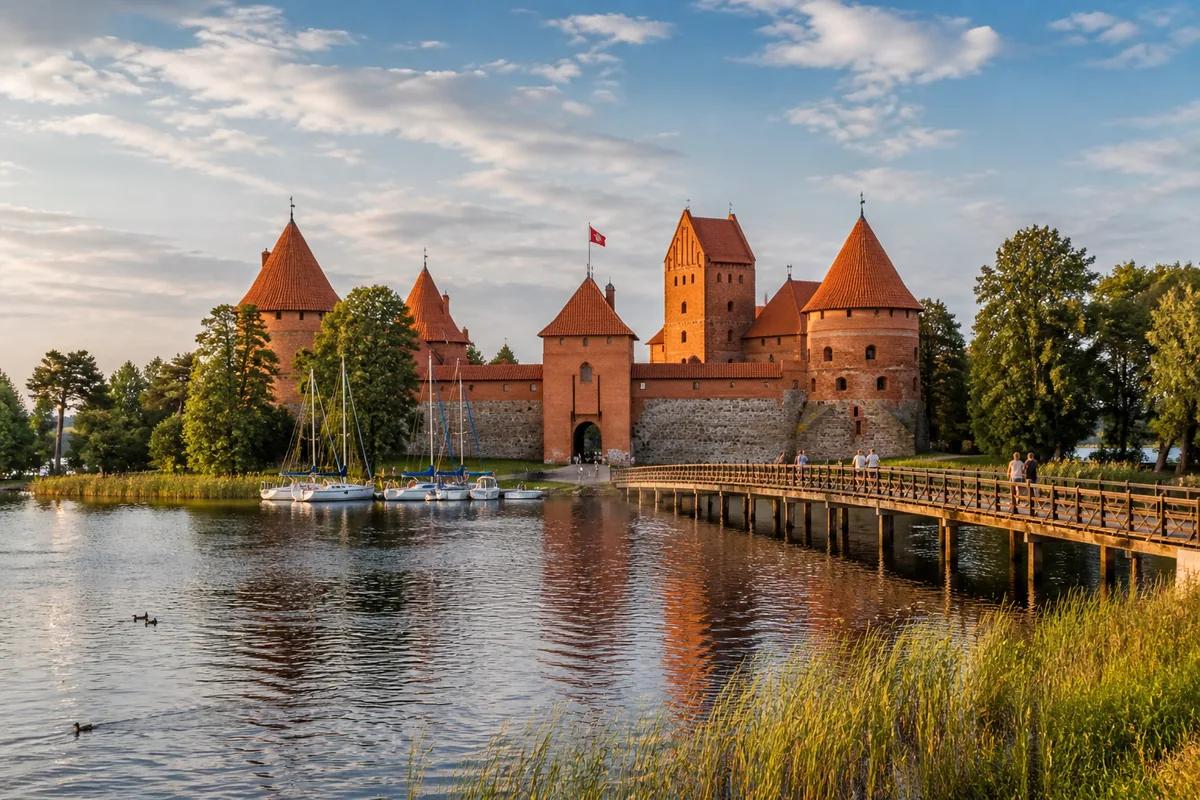
Trakai is a small town twenty-eight kilometres west of Vilnius, built on a narrow strip of land between three lakes - Galvė, Bernardinai and Skaistis - with a fourteenth-century brick castle on a small island in Lake Galvė as its centrepiece. The town has fewer than six thousand permanent residents but is one of the most-visited places in Lithuania thanks to that castle and the easy day-trip distance from the capital.
The castle is the visual definition of medieval Lithuania for most foreign visitors. Built between roughly 1370 and 1409 by Grand Dukes Kęstutis and Vytautas, it survived a brief golden age as the Grand Duchy's seat of power, fell into ruin after the seventeenth century and was extensively reconstructed during Soviet times. The result is somewhere between an authentic medieval fortress and a national-pride monument - but visually unmissable, especially from the lake.
Beyond the castle, Trakai has a layered character that rewards a longer visit than the typical three-hour day-trip allows. The Karaim community - descendants of Crimean Tatar Turks brought to Lithuania in the late fourteenth century - still maintains its distinct religion, language and food traditions in the town. The lakes themselves are popular for swimming, sailing and rowing. And the surrounding forests of the Trakai Historical National Park hide a number of smaller ruined castles, manor houses and quiet villages.
Trakai Island Castle
The Island Castle sits on a small island in Lake Galvė, reached by a long wooden footbridge from the eastern shore. The castle complex consists of a forecastle (the outer brick courtyard with corner towers) and a tall central residential keep, separated by a small inner courtyard. The original construction took about four decades and was completed under Grand Duke Vytautas in the early fifteenth century. After the 1410 Battle of Grunwald, where Vytautas defeated the Teutonic Knights, the castle had no military role and was used primarily as a residence and prison.
The castle museum inside the keep is small but well-curated. Permanent exhibitions cover the castle's construction, the wider history of the Grand Duchy of Lithuania, and a substantial collection of medieval coinage and ceramics. A reconstructed Great Hall on the upper floor hosts occasional summer concerts of medieval music. The signage is in Lithuanian, English, Russian and Polish; audio guides in those languages plus German are available at the entrance.
Tickets cost ten euros for adults and are bought at a small kiosk on the eastern shore before the footbridge. Last admission is one hour before closing, which is six in summer and four in winter. The castle is closed on Mondays from October to April. Booking online is not necessary but saves queueing time on summer weekends.
The lakes - Galvė, Bernardinai, Skaistis
Lake Galvė is the largest of the three lakes that Trakai sits between and the one most visitors associate with the town. It covers about three and a half square kilometres and has twenty-one small islands - the castle island is the largest and only inhabited one. The water is generally clean and pleasantly warm by July; an official swimming beach operates on the eastern shore during the summer.
Lake Bernardinai is smaller and quieter, on the southern side of the town, and has the best small-boat hire and rowing routes. Wooden rowing boats are rented by the hour from a small jetty next to the Užutrakis manor footpath. Lake Skaistis on the western edge is the deepest of the three at fifty metres and is the most popular for fishing.
Pleasure-boat trips around Lake Galvė run from the small harbour at the foot of the castle bridge, with departures every thirty to sixty minutes in summer. The standard route circles the castle island and the smaller wooded islets on the western half of the lake; longer trips include a stop at Užutrakis. Tickets are eight to twelve euros depending on the route. A pedalo-and-kayak rental operation runs from the same harbour.
Užutrakis Manor and park
Užutrakis Manor sits on a peninsula on the eastern shore of Lake Galvė, directly across from the Island Castle. The neoclassical mansion was built between 1896 and 1902 for the Tyszkiewicz noble family - the same family that built the Tiškevičius Palace in Palanga - and has been carefully restored over the past two decades. The interior is open as a museum, with most rooms restored to their late-imperial appearance.
The surrounding park is the bigger draw than the mansion itself. Designed by the French landscape architect Édouard François André, who also designed the Palanga botanical park, it covers eighty-five hectares of formal gardens, woodland paths and lakeside walks. The view of the Island Castle across the lake from the western edge of the park is the most photographed angle in Lithuania.
Užutrakis is reached on foot or by bicycle along the eastern lakeshore from Trakai town centre - a pleasant fifteen-minute walk through the wooded peninsula. By car, it is about three kilometres around the lake to the east. The park is free to enter and open year-round; the mansion museum charges five euros and is open daily except Mondays.
The Peninsula Castle
Less famous than the Island Castle but historically older is the Peninsula Castle (Pusiasalio pilis), the ruins of which sit on a small peninsula on the western side of Lake Galvė. This was the original Trakai castle, built around 1320 under Grand Duke Gediminas. Most of it is now low stone walls and earthworks, with one substantial corner tower partially restored.
The site is freely accessible and has English-language information panels explaining the castle's role as the original seat of the Trakai principality. The walk from the town centre takes about ten minutes; the surrounding woodland is part of the Historical National Park and has marked trails leading further west to smaller ruins.
For visitors with limited time, the Peninsula Castle is easy to skip in favour of the Island Castle. For visitors with a deeper interest in medieval Lithuanian history, the comparison between the two - pre-stone Gediminid versus high-medieval Vytautas-era - is genuinely informative and worth the half-hour detour.
Karaim heritage
The Karaim are one of the most distinctive ethnic minorities in Lithuania and Trakai is their cultural centre. Descendants of Crimean Tatar Turks brought to Lithuania around 1397 by Grand Duke Vytautas to serve as personal guards, the community has lived continuously in Trakai for more than six hundred years. Around thirty families remain today; the wider Karaim community in Lithuania numbers fewer than two hundred people, making it one of the smallest religious communities in Europe.
The Karaim religion is a non-Talmudic form of Judaism that recognises only the Hebrew Bible. The kenesa (Karaim place of worship) on Karaimų street in Trakai is one of only two functioning kenesas in Europe and is open to visitors most days; modest dress is appreciated. The small Karaim Ethnographic Museum next door has a good collection of textiles, household items and historical photographs, with English-language signage.
The Karaim language, a Turkic language now critically endangered, is still spoken by some elderly community members and is the basis of the elaborate inscriptions on the kenesa walls. Karaim cultural events, particularly the spring Karaim Cultural Days festival, are open to the public and give visitors a direct way to meet the living tradition.
Kibinai and the Trakai food scene
Kibinai are the dish that has made Trakai famous in Lithuanian gastronomy. They are crescent-shaped baked pastries - superficially similar to Cornish pasties or Argentine empanadas - filled traditionally with chopped lamb and onion, and increasingly with chicken, beef or vegetarian options. They are a Karaim invention and remain the most authentic Karaim food preserved in Lithuania.
Kibinai are sold from cafés and bakeries throughout the town, but the most established producers are the family-run kibinai bakeries on Karaimų street and Vytauto street. Senoji Kibininė and Kybynlar are the two best-known. A typical kibinas costs between two and four euros and is filling enough that two of them constitute a meal.
Beyond kibinai, Trakai's restaurant scene is solid but not extensive. Lake fish - perch, pike, zander - appears at every menu, often smoked or fried with traditional accompaniments. Several restaurants near the castle offer reasonable lunches with good lake views; quality and price track each other closely. For a quieter and more refined dinner, the restaurants around Užutrakis manor are better.
Activities and outdoor recreation
Boating on the lakes is the most distinctive Trakai activity. Beyond the standard pleasure-boat circuits and rowing-boat hire, the town hosts an active sailing school and rents small sailing dinghies by the half-day. The local sailing club organises weekly racing in summer that visitors can watch from the eastern shore.
Cycling is straightforward and rewarding. A marked cycle route runs around all three lakes - about twenty kilometres total - and connects the main sights with the surrounding villages. Bicycle rental shops are clustered around the bus station. Mountain biking through the deeper forest of the Historical National Park is more demanding but well-marked.
Walking trails inside the National Park lead to smaller medieval sites, abandoned manor houses and quiet villages. The full ten-kilometre Trakai-Senieji Trakai (Old Trakai) loop is the standard introduction; shorter half-day options branch off at multiple points. Information leaflets in English are available at the visitor centre near the bus station.
Where to stay in Trakai
Trakai works well for an overnight rather than just a day trip - the town empties out after the last bus to Vilnius leaves at six or seven in the evening, and the castle in the early morning before the day-trippers arrive is one of the more atmospheric experiences in Lithuania.
Hotels are clustered near the castle and along the eastern lakeshore. The Hotel Galvė is the largest and most central; its lake-view rooms cost €100–140 a night in summer. Several smaller boutique hotels and B&Bs in the historic town centre fall in the €70–100 range. A few self-catering cottages along the southern shore of Lake Bernardinai are quieter and family-friendly.
For a more atmospheric stay, several restored manor houses and rural sodybos within fifteen kilometres of the town offer lakeside cottages, sauna access and small garden settings. These are most easily found through Sodybos.lt and are best booked at least three weeks ahead in summer. A dedicated accommodation guide for Trakai is in development.
Getting to and around Trakai
From Vilnius, Trakai is the easiest day trip in Lithuania. By car the drive on the A1 motorway takes thirty to forty minutes; parking is plentiful at two large car parks near the castle and one on the western edge of the town. Tour buses use a separate parking lot and follow a designated drop-off point.
Public transport is straightforward. Buses leave Vilnius bus station every thirty minutes in the morning and roughly hourly in the afternoon; the journey takes about forty-five minutes and tickets cost three to four euros each way. The bus terminus in Trakai is a five-minute walk from the castle approach. Trains run six times a day and take half an hour; the Trakai station is about a kilometre from the historic centre.
Within Trakai itself, walking is the natural choice. The town centre is compact and the major sights are within fifteen minutes of each other on foot. Tourist-oriented horse-and-carriage tours operate during summer at fixed routes from the castle entrance.
Best time to visit
May through early October is the realistic visiting season. July and August are by far the busiest - the castle approach can be crowded by mid-morning and parking fills up before noon. Visiting on a weekday outside the peak weeks gives a noticeably calmer experience. Late spring and early autumn are arguably the most attractive: the lake shore is greener, the light is softer and the crowds are thinner.
September brings the Trakai festival of medieval re-enactment, which fills the town with costumed performers and craft stalls for a long weekend in early September. The Karaim Cultural Days, in late May, is the equivalent culturally focused event.
Winter is dramatic in a different register. The castle in snow is one of the Lithuanian images. Lake Galvė freezes solidly in most winters and supports ice fishing, ice skating and - when conditions allow - winter sailing. Restaurants and most hotels stay open year-round, but boat hire and several smaller museums close from November to March.
Practical tips
Book the Užutrakis manor museum visit in advance for July and August - entry is by timed slot and weekend afternoons fill up two or three days ahead. The Island Castle is walk-up only and the queue moves reasonably fast even on busy days.
For photography, the best castle views are from the western shore of Lake Galvė at sunrise (light hits the eastern wall) and from Užutrakis park at sunset (light hits the western face). A wooden footbridge directly south of the castle gives the classic frontal angle but is busiest mid-morning.
English is widely spoken by hotel and restaurant staff, less so by older shop and bakery owners. A few words of Lithuanian are appreciated; Russian and Polish are also commonly understood given the cross-border traffic. Karaim is heard occasionally on Karaimų street but as a heritage language only.
Cash is rarely needed; cards are accepted everywhere except a handful of food stalls. ATMs are reliable in the town centre. Mobile signal is good throughout the historic area but drops in the deeper woodland of the National Park.