What kugelis is
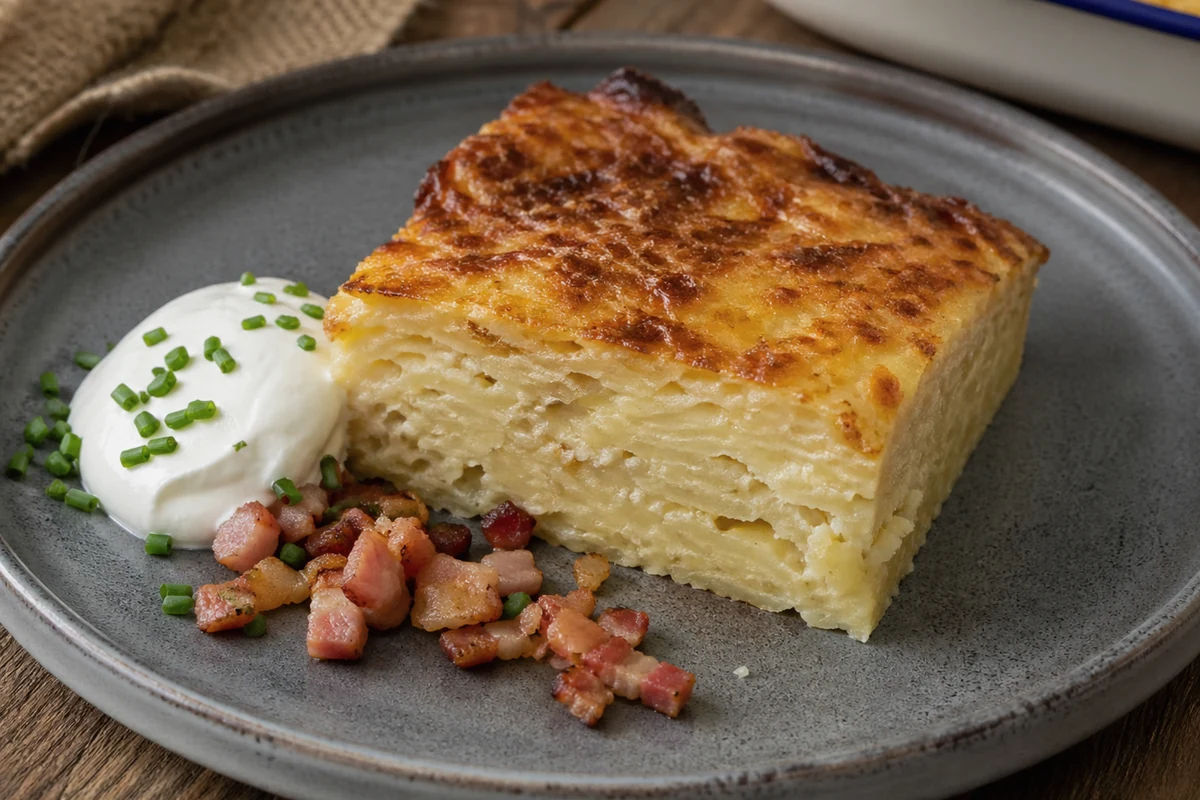
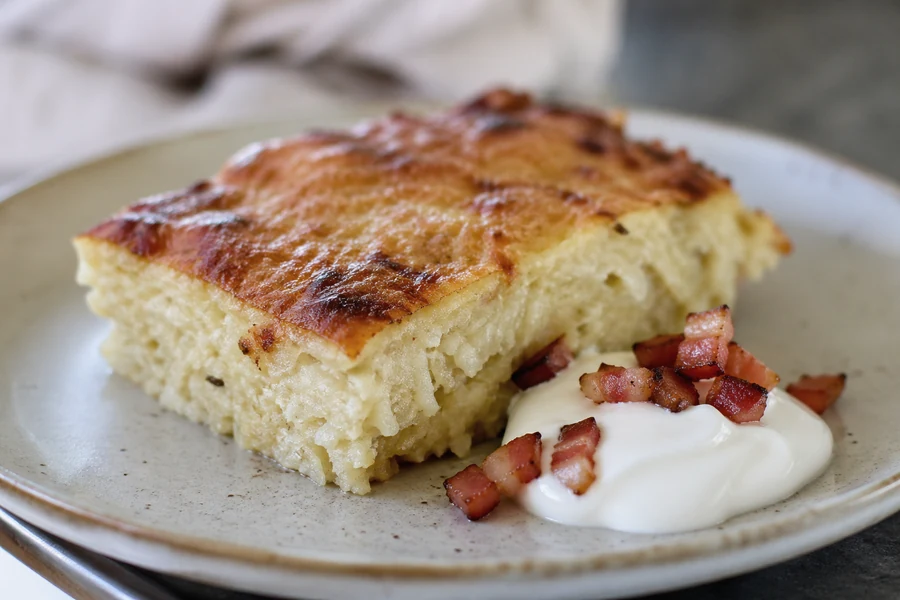
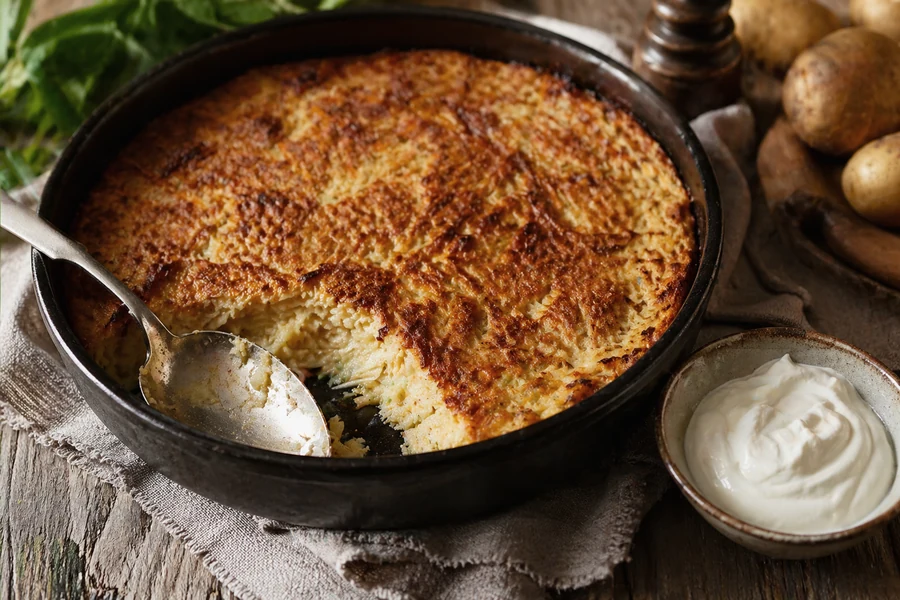
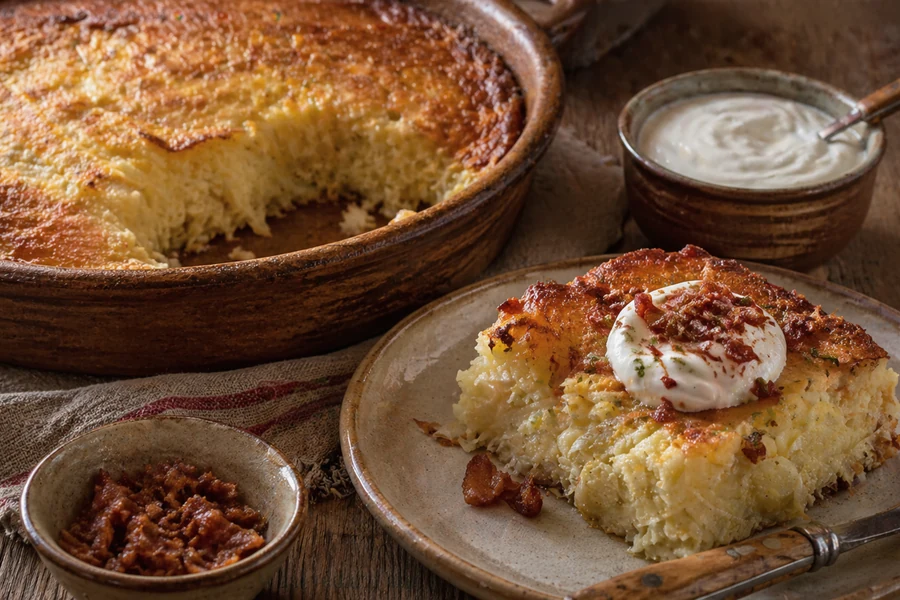
Kugelis is a baked potato pudding made from grated raw potato bound with eggs, milk and rendered bacon fat, baked in a wide tray until the top is dark golden brown and the inside is firm but still slightly soft. It is dense, savoury and deeply satisfying, with an almost custard-like internal texture and a crisp, browned top crust. A standard portion is a thick rectangular slab roughly the size of a paperback book, served with sour cream and lingonberry jam.
It is the everyday-but-Sunday-special dish of Aukštaitija and Lithuanian-American kitchens, with a counterpart kitchen tradition among Litvak Jewish families that brought a parallel version (kugel) into the broader Ashkenazi food canon. The Lithuanian version is rooted in pork fat and bacon; the Litvak version is traditionally made with rendered chicken or goose fat to remain kosher. Both share the same fundamental method.
History and origins
Kugelis as we know it today is a product of the nineteenth-century potato boom in Lithuania. Before potatoes became a staple after the 1840s famine, similar baked savoury puddings existed using grain - oat groats and buckwheat were the usual foundation. Once potatoes took over the rural diet, the recipe shifted to potato within roughly a generation, and the modern kugelis recipe was settled by the late 1800s.
The name itself is Yiddish-derived. "Kugel" in Yiddish means a baked pudding (originally a sweet noodle dish; the savoury potato version is a later Eastern European innovation). The word entered Lithuanian via the substantial Litvak Jewish presence in the country - before the Holocaust, Lithuanian Jews represented a tenth of the population and were heavily concentrated in Aukštaitija and Vilnius. Many traditional Lithuanian dishes (kugelis, kibinai-style pastries, certain rye-bread traditions, and the Vilnius style of cold fish appetisers) reflect this shared cultural kitchen.
After the Holocaust, the Litvak food tradition largely disappeared from Lithuania itself but was carried forward by Lithuanian-American Jewish communities, particularly in Chicago and Boston, where kugel and kugelis are now sold side-by-side at Lithuanian-Jewish delis. In Lithuania today, kugelis is unambiguously a Lithuanian dish on every restaurant menu, but the shared origin is increasingly recognised in cookbooks and cultural writing.
Regional variations
The most common variation is the binding agent. Aukštaitija and Žemaitija recipes use eggs and bacon fat as the primary binders. Suvalkija recipes sometimes add a small amount of plain flour for a firmer set. Lithuanian-American recipes often add evaporated milk for a richer texture.
The fat is the next variable. Traditional kugelis uses smoked bacon (rūkyta šoninė) rendered down before mixing into the potato mixture. Some regional versions use a mix of bacon and pork belly; others use only the pork-belly fat with no smoke. The Litvak Jewish version uses goose or chicken fat (schmaltz).
Texture varies more than the recipe itself: some cooks prefer a wetter, custard-like centre; others bake longer for a firmer, almost cake-like cross-section. Both are valid and both have their defenders. The crust is non-negotiable: it should be deep golden brown and crisp.
Common mistakes
The first mistake is not squeezing enough liquid out of the grated potato. Kugelis dough should be thick and stiff, not runny. A wet mixture gives a soggy pudding.
The second mistake is too much egg. Two to three eggs per kilogram of potato is the standard ratio; more eggs make the kugelis too custardy and lose the potato character.
The third mistake is not pre-rendering the bacon. The bacon fat needs to be hot and rendered when it goes into the potato mixture, not raw or cold. The rendered fat coats the potato strands and gives kugelis its characteristic flavour.
Finally, do not rush the bake. Kugelis needs at least 90 minutes at moderate heat to develop the dark crust and cooked-through interior. Pulling it out early gives a pale, undercooked pudding.
How to serve kugelis
Serve hot, in thick rectangular slabs, with a generous spoonful of cold sour cream on top and a small dish of lingonberry jam (or any tart fruit preserve) on the side. The hot-cold-sweet-sour combination is the canonical serving, and kugelis without sour cream is considered incomplete by most Lithuanians.
A green salad or pickled cucumbers help balance the richness. Kugelis is typically a main course rather than a side, given its density. Beer pairs well; a strong dark Lithuanian beer is the traditional choice.
Reheating leftovers: kugelis reheats well in the oven (180C, 15-20 minutes covered, then 5 minutes uncovered to crisp the top). Microwaving works but loses the crust. Cold kugelis with sour cream is also good as a breakfast leftover - this was the traditional Monday morning use of Sunday's leftover kugelis.
Where to try the best ones in Lithuania
In Vilnius, Etno Dvaras and Saula chain locations both serve a reliable kugelis. The home-style restaurant Mėta in the Užupis district is a good slightly-upscale version. The traditional canteen-style Trys Mergelės serves a no-nonsense canonical version at a fair price.
In Kaunas, the older restaurants in the Old Town (Bernelių Užeiga, Avilys) all do solid kugelis. For a regional version, Anykščiai (Aukštaitija) is the heartland: any small home-style restaurant in the town centre will serve kugelis as the default Sunday lunch option.
Sodybos in the Aukštaitija National Park frequently include kugelis on their evening menus when feeding guests; this home-cooked version is generally the best version most travellers will encounter.
Ingredients (serves 6-8)
- 2 kg waxy potatoes, peeled
- 300 g smoked bacon (rūkyta šoninė) or thick-cut streaky bacon, diced small
- 2 large onions, finely chopped
- 3 large eggs
- 200 ml whole milk (or evaporated milk for richer version)
- 1 tablespoon plain flour (optional, helps binding)
- 1.5 teaspoons salt
- 1 teaspoon black pepper
- 1/4 teaspoon ground nutmeg (optional, traditional in some Aukštaitija versions)
- 1 tablespoon lemon juice or white vinegar (prevents potato discolouring)
- Butter or pork fat for greasing the baking dish
- To serve: 300 ml sour cream, lingonberry jam
Method
- Preheat oven to 180C (160C fan). Generously grease a deep oven dish (about 30 by 20 cm) with butter or pork fat.
- Render the bacon: place the diced bacon in a cold heavy frying pan and cook over low-medium heat until the fat renders and the pieces are crisp, about 10-12 minutes. Add the chopped onion in the last 4 minutes and soften. Remove from heat but keep warm.
- Grate the peeled potatoes on the finest holes of a grater (or use a food processor). Add the lemon juice immediately. Working in batches, transfer to a clean tea towel or muslin and squeeze hard over a bowl. Reserve the squeezed liquid.
- Let the squeezed liquid sit for 10 minutes so the starch settles to the bottom. Pour off the cloudy water and reserve the white starch.
- In a large bowl, combine the squeezed grated potato, the reserved starch, the bacon-and-onion mixture (with all its rendered fat), beaten eggs, milk, optional flour, salt, pepper, and nutmeg. Mix thoroughly with a wooden spoon. The mixture should be thick.
- Pour into the greased baking dish and smooth the top. The mixture should be about 4-5 cm deep.
- Bake for 90 minutes, until the top is dark golden brown and a knife inserted in the centre comes out clean. If the top browns too quickly in the first hour, cover loosely with foil and remove for the last 15 minutes.
- Let rest for 15 minutes before cutting. Slice into thick rectangular pieces and serve hot with cold sour cream and lingonberry jam.