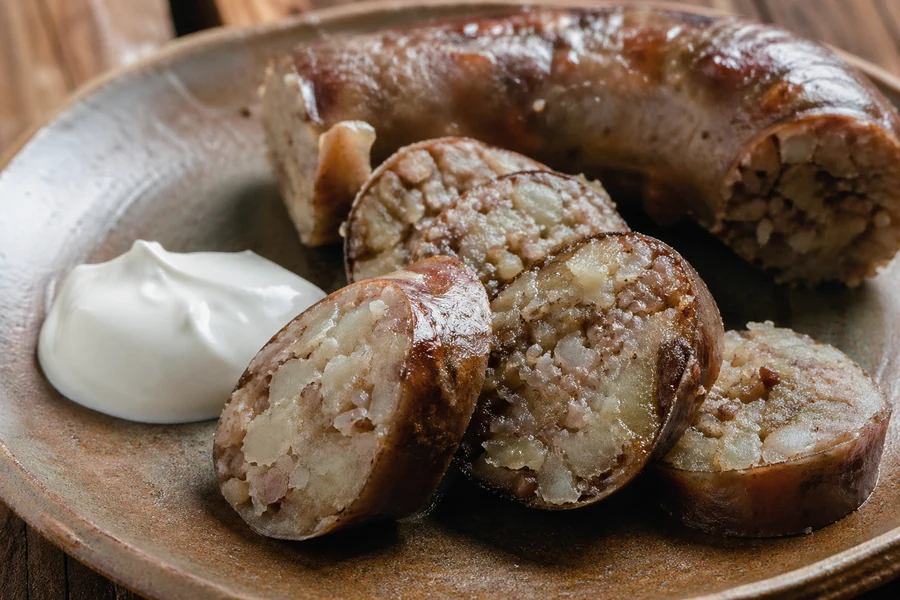
What vėdarai are
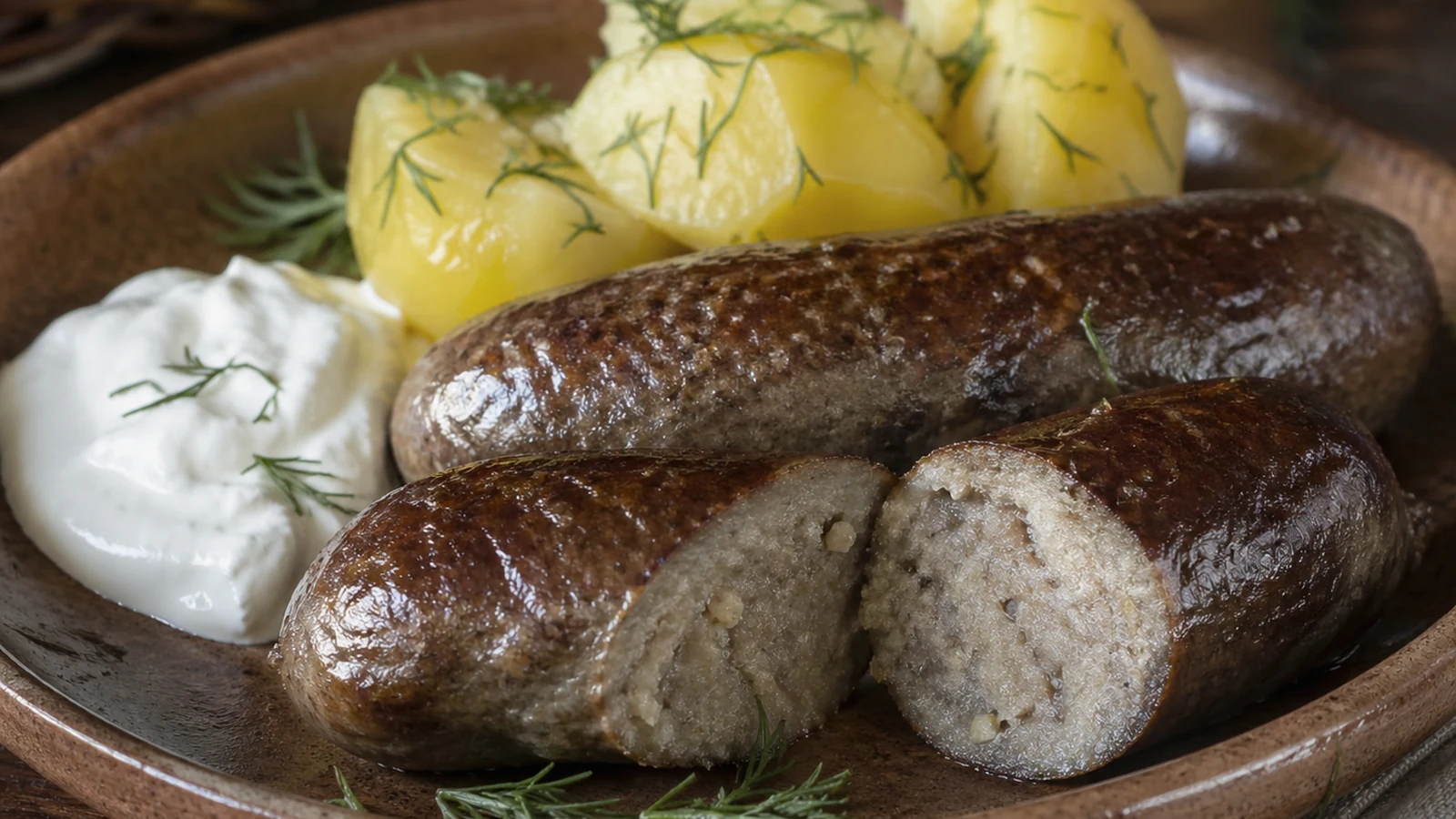
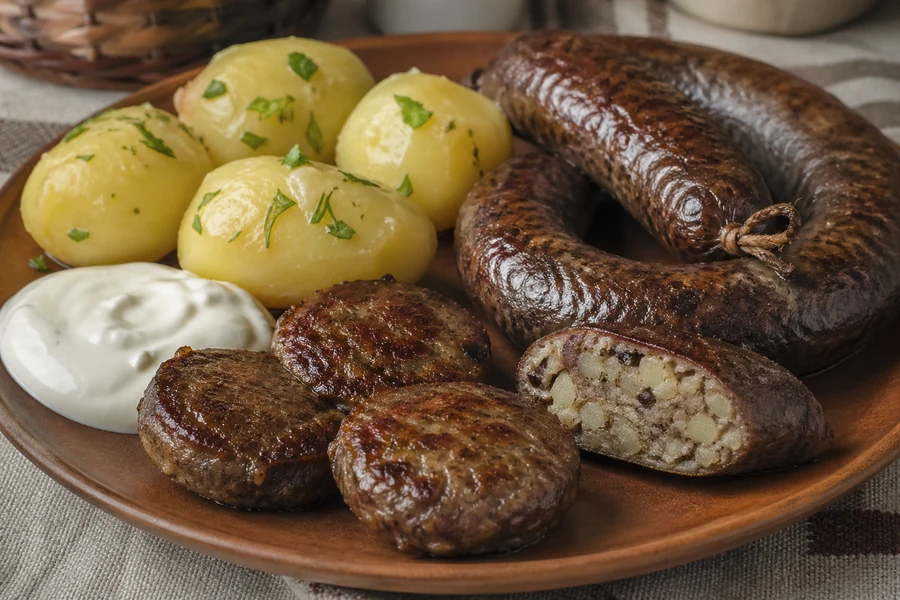
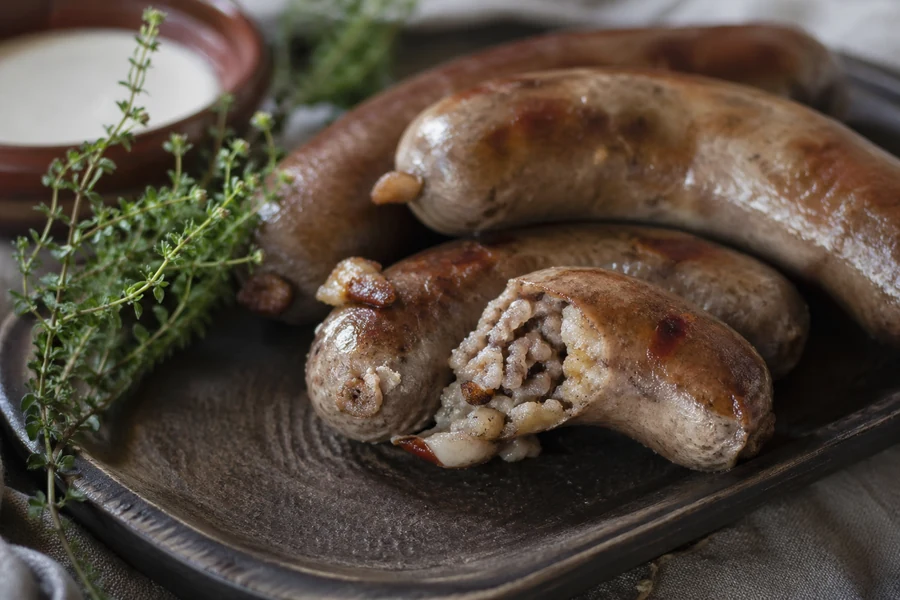
Vėdarai are sausages made by stuffing a mixture of grated raw potato, finely chopped bacon and onion into natural pork intestine casings, then baking the filled sausages on a tray with butter and a little water until the skin is crisp and the inside is firm. The result is a long sausage roughly 30-40 centimetres in length and 4 centimetres in diameter, sliced into thick rounds for serving.
They are dense, savoury and deeply flavoured by the rendered bacon fat that absorbs into the potato during baking. A standard portion is two or three thick slices per person, served hot with sour cream and sauerkraut. The dish is closely related to the broader Eastern European tradition of potato-stuffed sausages (Polish kiszka ziemniaczana, Belarusian kishka, German Kartoffelwurst) but the Lithuanian version is distinctively low on grain fillers and high on potato.
History and origins
Vėdarai are a Žemaitija (Samogitia) regional speciality dating to the late nineteenth century, when potatoes had become the staple of rural cooking but pig-slaughter (kiaulių pjovimas) remained the central event of the rural autumn calendar. Vėdarai use parts of the pig - the intestine casing and rendered fat - that were otherwise difficult to store, so the dish emerged as a practical post-slaughter way to use everything from the autumn pig.
The Žemaitija dialect word "vėdarai" originally meant the casings themselves (the word literally translates as "intestines"), and the dish name effectively means "intestines [stuffed with potato]". Different regions of Lithuania use different words for this same dish - bulvinės dešros (potato sausages) is the standard Lithuanian, vėdarai is the Žemaitija-specific term. Both refer to the same thing.
The dish travelled with the Lithuanian diaspora to Chicago, Boston and Pennsylvania during the great emigration of 1880-1920. Lithuanian-American delis still sell vėdarai (often labelled "Lithuanian potato sausage") and they are a fixture of Lithuanian-American Christmas tables. Within Lithuania itself, the dish remains most strongly identified with Žemaitija and with autumn-winter cooking; many Vilnius restaurants only serve them seasonally.
Regional variations
The most common variation is the seasoning. Žemaitija recipes are kept simple - bacon, onion, salt, pepper, marjoram - to let the potato character carry the dish. Eastern Lithuania (Aukštaitija) sometimes adds caraway seeds, which is uncommon in the western version. Lithuanian-American versions often add garlic, which is a clear departure from the Lithuanian tradition.
The fat ratio varies. Traditional Žemaitija recipes use a roughly 1:4 ratio of bacon to potato by weight; richer versions go up to 1:3, leaner ones down to 1:6. The richer the version, the more "buttery" the cooked vėdarai will taste; the leaner versions are firmer and more potato-forward.
Method varies between baking and smoking. The standard modern version is oven-baked. The traditional rural version was smoked in a small wood-smoke chamber for several hours, then refrigerated and reheated for serving. Smoked vėdarai are still produced commercially by some Žemaitija butchers and are worth seeking out at a Žemaitija farmers' market or specialist shop.
Common mistakes
The first mistake is overstuffing the casings. Vėdarai expand during baking; casings should be filled to about 75% of capacity, with twists or knots between sausages to allow expansion.
The second mistake is too wet a filling. Like cepelinai and kugelis, the grated potato must be well-squeezed before mixing. Wet filling means soggy vėdarai and burst casings.
The third mistake is too high an oven temperature. Vėdarai bake at 170-180C, slowly, for at least an hour. Higher temperatures burst the casings before the inside cooks through.
Finally, do not skip the basting. Brushing the sausages with rendered bacon fat or butter every 20 minutes during baking gives the characteristic deep brown skin and prevents drying.
How to serve vėdarai
Slice the cooked sausage into thick rounds (about 2 centimetres) and serve hot, two or three slices per portion, with cold sour cream and sauerkraut on the side. The cold-warm-rich-sour combination is the canonical Žemaitija serving and works extremely well.
A glass of cold local beer (Žemaitijos Alus, the regional brewery from Telšiai, makes a beer specifically marketed for sausage dishes) is the traditional pairing. Lithuanian gira works for non-beer drinkers. A small dish of horseradish-and-beet preserve (krienai su burokais) is the traditional condiment beyond sour cream.
Vėdarai are usually a main course rather than a side, given the density. They reheat well; cold leftover vėdarai with bread the next day is a Žemaitija breakfast tradition.
Where to try them in Lithuania
In Žemaitija, the small towns of Telšiai, Plungė and Plateliai all have restaurants serving traditional vėdarai. The Telšiai market sells smoked vėdarai from local butchers from October through March; this is the closest most travellers will get to the home-cooked version.
In Vilnius, the restaurants Etno Dvaras, Saula and Senoji Trobelė all serve vėdarai when in season (October through April). Forto Dvaras runs a "Žemaitija menu" rotation in November that features them as the main course.
Sodybos in the Žemaitija National Park serve home-cooked vėdarai routinely in autumn-winter; the Plateliai-area sodybos in particular are known for them.
Ingredients (serves 6-8, makes ~4 sausages)
- 1.5 kg waxy potatoes, peeled
- 300 g smoked bacon (rūkyta šoninė), finely diced
- 2 large onions, finely chopped
- 2 large eggs
- 1.5 teaspoons salt
- 1 teaspoon black pepper
- 1 teaspoon dried marjoram
- 1 tablespoon lemon juice or white vinegar (prevents potato browning)
- 2 metres of natural pork intestine casings (available at butchers)
- 50 g butter, melted, for basting
- To serve: 300 ml sour cream, 400 g sauerkraut
Method
- Soak the pork casings in cold water for at least 1 hour, ideally overnight, changing the water twice. This softens them and removes the salt they are packed in. Rinse the inside by running cold water through them just before stuffing.
- Render the bacon: place the diced bacon in a cold heavy frying pan and cook over low heat until the fat renders and the pieces are crisp, about 12-15 minutes. Add the chopped onion in the last 4 minutes. Cool slightly.
- Grate the peeled potatoes on the finest holes. Add the lemon juice immediately. In batches, place in a clean tea towel and squeeze hard. Reserve and let the squeezed liquid sit so the starch settles; pour off the cloudy water and reserve the white starch.
- In a large bowl combine the squeezed potato, reserved starch, bacon-onion mixture (with rendered fat), eggs, salt, pepper, and marjoram. Mix well.
- Slip a casing onto a sausage stuffer (or fit a wide funnel into one end). Spoon the filling in, pushing it through, until the casing is about 75% full. Tie or twist into 30-40 cm sections. Make 4 sausages.
- Preheat oven to 180C. Place sausages on a heavy baking tray with a few tablespoons of water in the bottom. Pierce each sausage carefully twice with a sharp pin to allow steam to escape.
- Bake for 90 minutes, basting with melted butter every 20 minutes. The skin should be deep golden brown and slightly crisp at the end.
- Rest for 10 minutes. Slice into 2 cm thick rounds and serve hot with cold sour cream and sauerkraut.