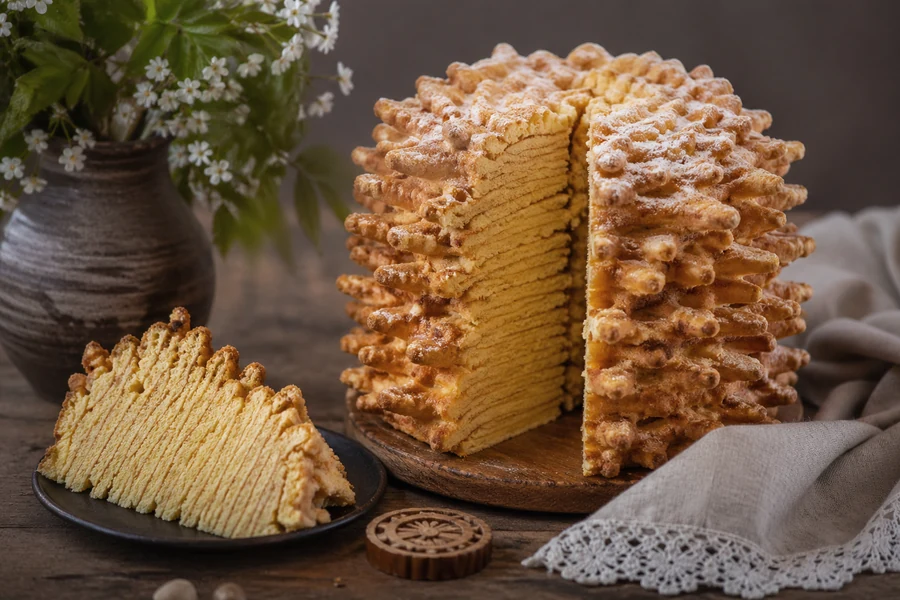
What šakotis is
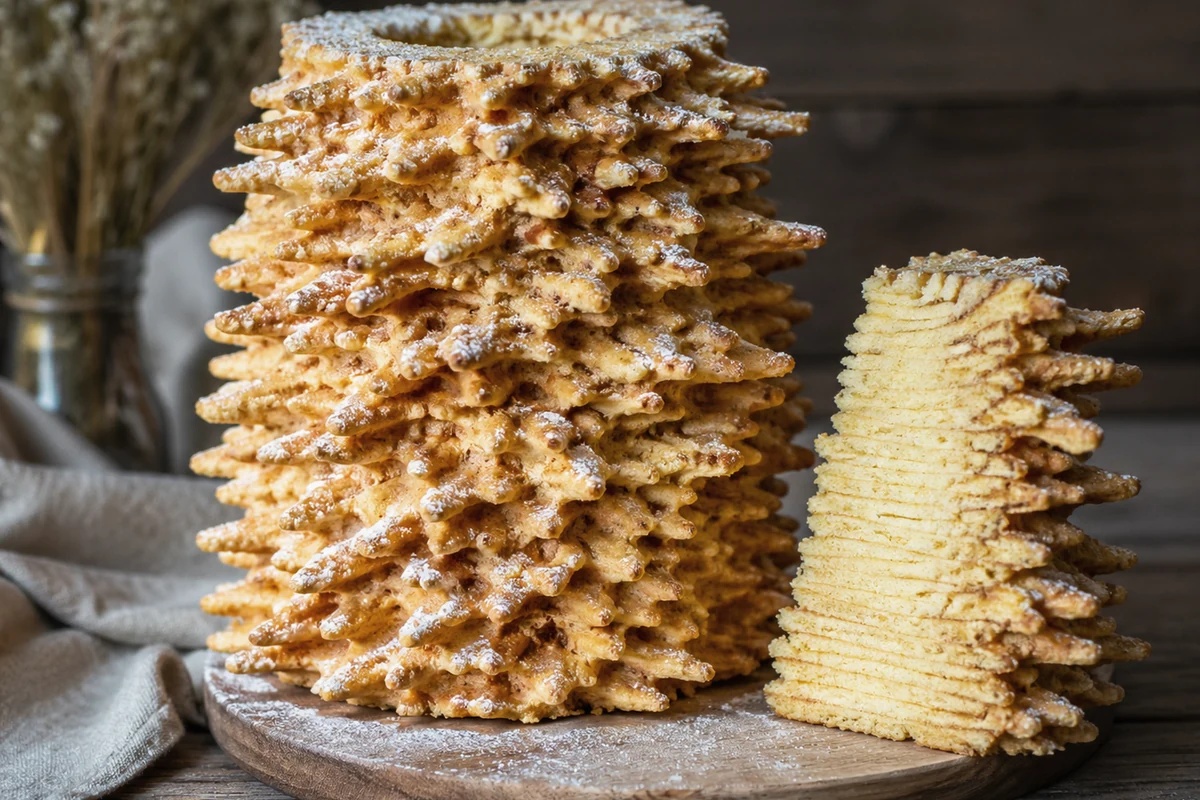
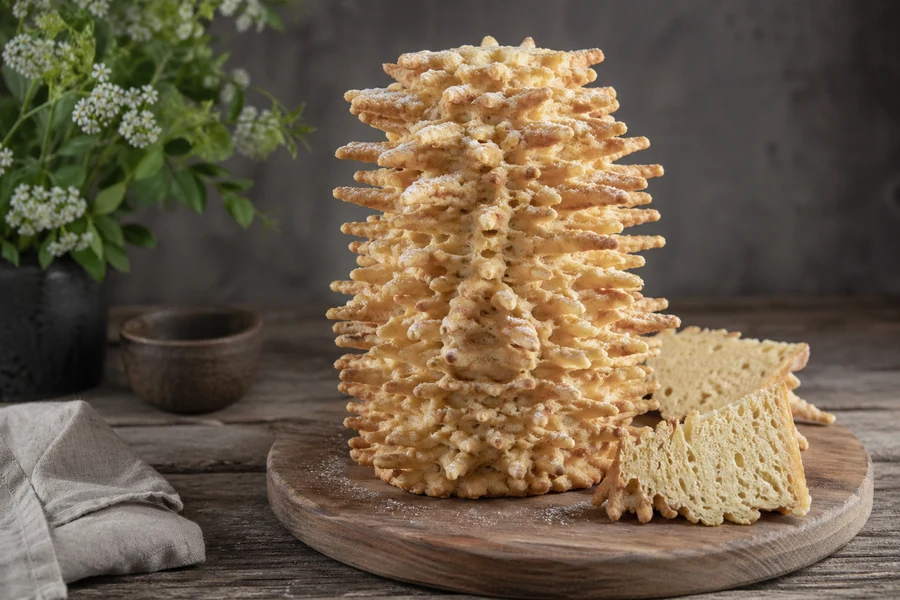
Šakotis (literally "branched") is a tall, spike-covered cake made by ladling thin yolk-rich batter onto a slowly rotating wooden spit over a coal fire, layer by layer, until the cake builds up to roughly 30-50 centimetres tall and 20 centimetres wide. As each layer cooks, drips of batter form the characteristic horizontal branching spikes that give the cake its name and silhouette. A finished traditional šakotis weighs 2-4 kilograms and stands as a centrepiece on the celebration table.
It is genuinely spectacular and unmistakably Lithuanian. The closest cousin is the German Baumkuchen, which is similar in technique but smoother and without the distinctive spikes. The Polish sękacz is essentially the same dish - the Polish-Lithuanian Commonwealth shared kitchens and the cake travelled freely between them. In Lithuania today šakotis is most strongly associated with the Suvalkija region, particularly the area around Vilkaviškis and Marijampolė, but it is now baked nationally for weddings and Christmas.
History and origins
Šakotis arrived in the Polish-Lithuanian Commonwealth from the German court tradition in the sixteenth or seventeenth century, possibly via the Sasų royal patisseries or via direct exchange with East Prussian bakers. The first documented Lithuanian recipes appear in eighteenth-century manor-house cookbooks, where it was a celebration cake for the noble class.
Through the nineteenth century the cake spread from manor kitchens into peasant celebration cooking, particularly in Suvalkija where the rural prosperity of the region (the country's richest agricultural land) supported the kind of indulgent ingredient lists that šakotis demands - one cake takes 50-70 egg yolks, 500-700 grams of butter, and considerable sugar. By the late nineteenth century it was the standard Suvalkija wedding cake and was beginning to spread elsewhere in Lithuania.
The Soviet period reinforced šakotis's celebration status because the ingredient costs effectively limited it to special occasions even when shop-bought versions were available. The current shop-cake industry developed after independence in the 1990s; today most Lithuanian supermarkets carry several brands of pre-baked šakotis at any time, and the artisanal versions made by traditional bakers in Druskininkai and Vilkaviškis are exported across Europe and to the Lithuanian-American diaspora.
Why the cake has spikes
The spikes are not decorative - they are a structural consequence of the rotating-spit cooking method. As the wooden spit rotates over the heat, ladled batter drips off the bottom of the spit before fully setting. Some drips fall away and burn off; others, where the batter is thicker or the temperature is right, partially set into hanging strands. Subsequent layers of batter coat these strands, building them outward into the characteristic horizontal spikes.
The number, size and pattern of spikes is the visible marker of how the cake was made. A traditional spit-roasted šakotis from a careful baker has long, even spikes; a rushed cake has short, irregular ones; an oven-baked home version has no spikes at all (which is acceptable but loses much of the visual character). The most respected Suvalkija bakers compete for the tallest, most distinctive spikes - a fully-developed traditional šakotis can have spikes 5-7 centimetres long.
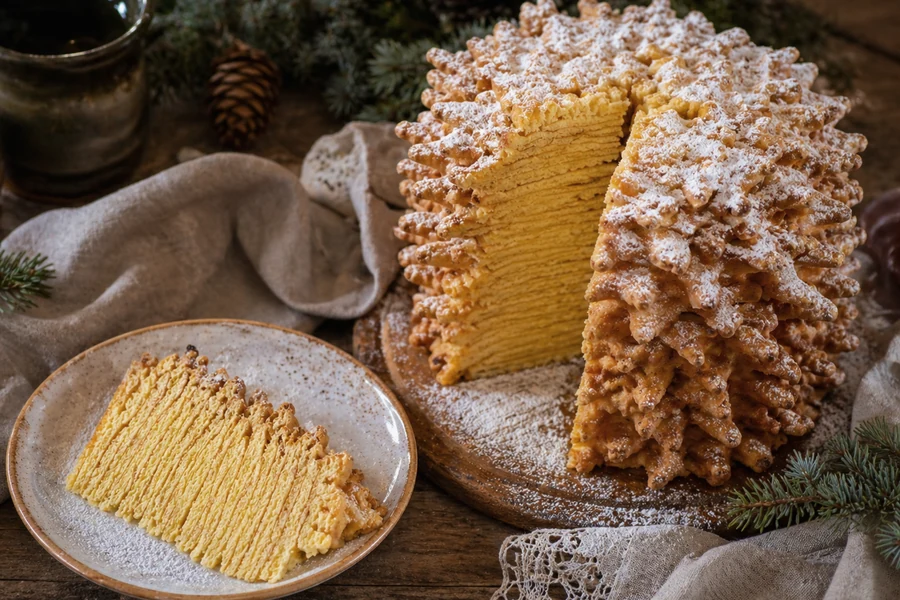
Spikes also have a practical eating function: they break off cleanly along the layered structure, so a šakotis is sliced not in wedges but in thin horizontal slices, each slice itself a complete miniature cake-with-spikes. The structure makes šakotis easy to share at large celebrations.
The home oven version (without a spit)
Authentic šakotis cannot be made at home without a rotating spit. The spit-version requires a wooden spit, a coal fire, and an experienced baker with several hours of attention. Most home cooks instead make a "šakotinis pyragas" - a layered yolk-rich cake baked in a tube tin that approximates the flavour but not the spikes.
The oven version is essentially a layered Bundt cake baked in repeated thin layers (each ladled on, baked briefly, then the next layer added). It takes roughly 90 minutes total but gives an excellent flavour result. The recipe below is the home oven version; a traditional spit version is best bought from a Suvalkija bakery rather than attempted.
Common mistakes (oven version)
The first mistake is rushing the layering. Each layer must be just barely set before the next is added; pour too soon and the layers blur together into a generic Bundt; wait too long and the layers separate and the cake falls apart.
The second mistake is too thick a batter. Šakotis batter should be pourable, not spoonable. Thicker batter gives a heavier cake without the characteristic light layered structure.
The third mistake is too many egg whites. The cake is yolk-rich; whites are added only modestly to keep the structure light. Most recipes use 12-16 yolks but only 4-6 whites for a half-size home cake.
Finally, do not skip the cooling step before slicing. Šakotis improves overnight as the layers settle and the flavour deepens.
How to serve šakotis
Slice horizontally in thin discs (1.5-2 cm thick), one disc per person. The disc is itself a complete miniature šakotis with its own pattern of spikes. Serve with strong black coffee, hot tea, or a small glass of dessert wine; cream and sweet alcohol both pair well.
At weddings and Christmases the cake is the centrepiece of the dessert table; it is brought out whole, presented to the room, then sliced at the table. A traditional Suvalkija wedding šakotis is decorated with green-and-white ribbons; a Christmas šakotis is decorated with cranberries and silver pearl sugar.
Šakotis keeps for two to three weeks at room temperature in a sealed container, and longer in the fridge. It can also be sliced and dried into long-term storage rusks - a Suvalkija tradition for using up the post-celebration leftovers.
Where to buy and try the best ones in Lithuania
In Suvalkija, the village of Vilkaviškis and the town of Marijampolė have the most respected traditional bakeries. Romnesa, Dvaro Šakotis and Senoji Suvalkija are three established producers exporting nationally; their cakes are available at most supermarkets and at the bakery storefronts in the towns.
In Druskininkai (Dzūkija), the spa-town visitor trade has supported a parallel artisanal šakotis tradition for over a century; the Druskininkų Šakotis brand is widely available.
To see šakotis fresh from the spit, look for Suvalkija and Marijampolė regional fairs (held in summer and at Christmas), where a working spit baker often demonstrates the traditional technique - the most practical way for most travellers to see how a real šakotis is made.
Ingredients (oven version, serves 12-15)
- 12 large egg yolks
- 6 large egg whites
- 300 g unsalted butter, very soft
- 300 g caster sugar
- 300 g plain flour, sifted
- 100 ml double cream
- 1 teaspoon vanilla extract
- 1 teaspoon baking powder
- 1/2 teaspoon salt
- Zest of 1 lemon (optional, traditional in Suvalkija)
- Icing sugar to dust
- Special equipment: a tall tube/Bundt tin or angel-food cake tin
Method
- Preheat oven to 190C (170C fan). Generously butter a tall tube or angel-food cake tin and dust with flour.
- Cream the very soft butter with the sugar until pale and fluffy, about 5 minutes with an electric mixer.
- Add the egg yolks one at a time, beating well after each. The mixture should be very pale and thick.
- Beat in the cream, vanilla, and lemon zest. Sift the flour, baking powder and salt over the mixture and fold in gently.
- In a separate clean bowl, beat the egg whites to firm peaks. Fold gently into the yolk mixture in three additions, keeping as much air as possible.
- Ladle a thin layer of batter (about 100 ml) into the tin, spreading evenly. Bake for 5-7 minutes until just set on top.
- Remove briefly from oven, ladle the next thin layer over the first, and return to the oven for another 5-7 minutes. Repeat layer-by-layer until all batter is used (about 8-10 layers, 60-70 minutes total layering time).
- For the last layer, bake longer (10-12 minutes) until deep golden on top. Cool in the tin for 30 minutes, then turn out carefully. Cool completely. Dust with icing sugar before serving. Best after resting overnight.