What spurgos are
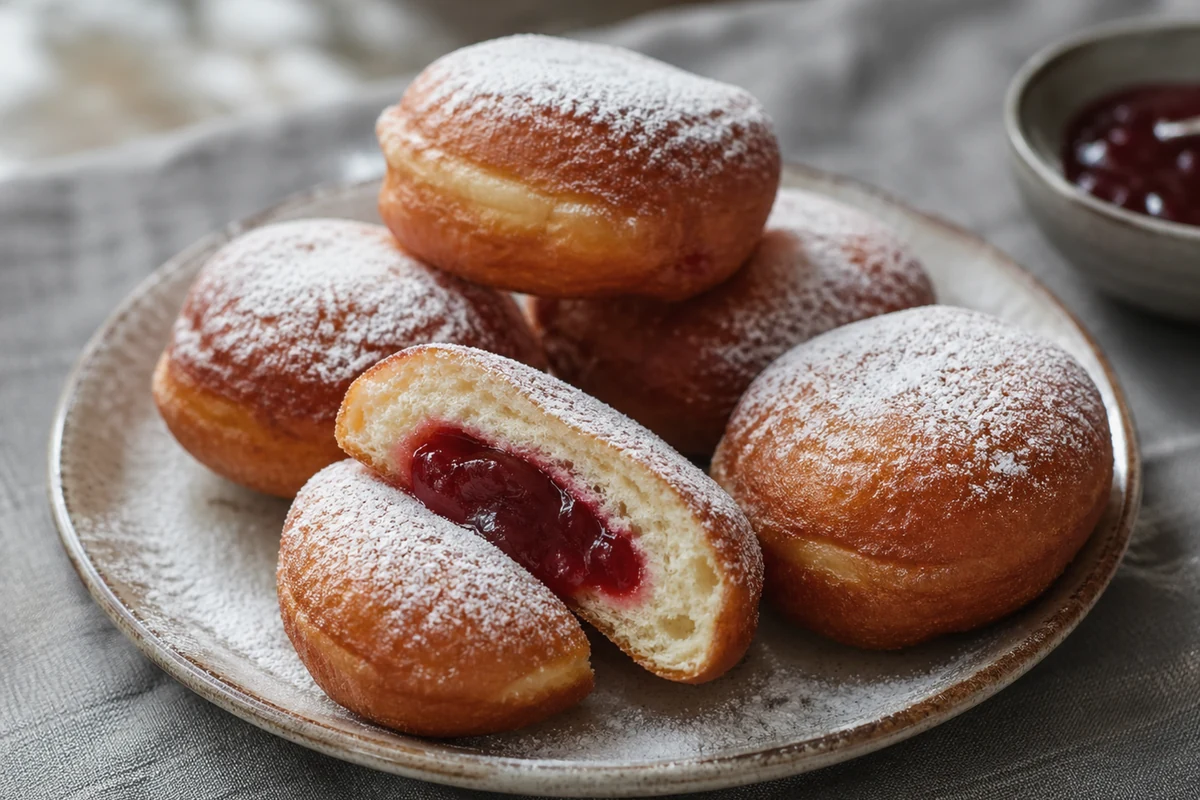
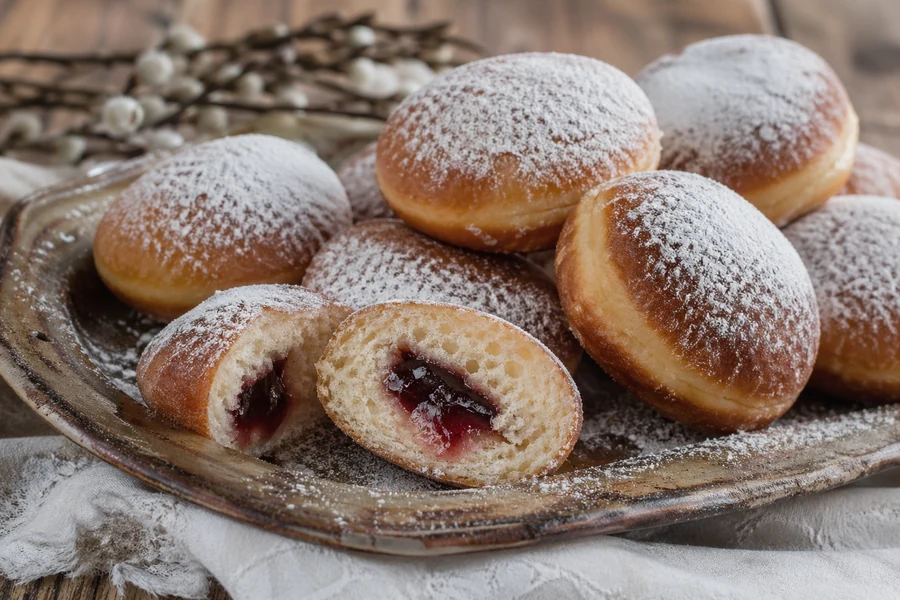
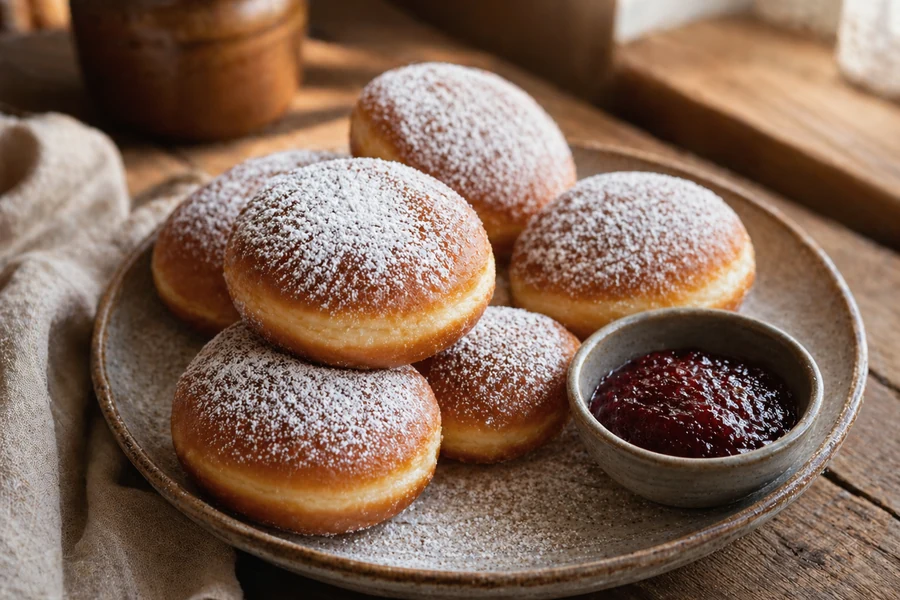
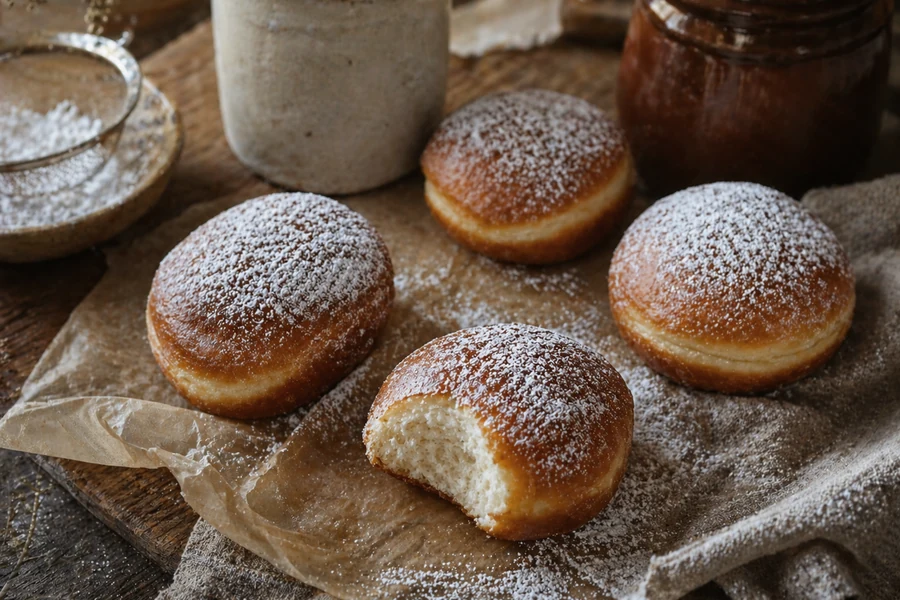
Spurgos are deep-fried yeasted doughnuts roughly 6-8 centimetres in diameter, golden brown on the outside, soft and slightly sweet inside, and dusted with icing sugar or rolled in granulated sugar after frying. Some versions are filled with rose-petal jam, plum jam or curd cheese; the simplest and most common are unfilled and just sugar-dusted.
They are the Lithuanian counterpart to Polish pączki, German Berliner, and the broader Eastern European doughnut tradition that dominates pre-Lent carnival foods. A standard portion is two or three doughnuts; they are eaten warm if possible (within an hour of frying is ideal), as a sweet snack, dessert or street food. Spurgos are sold year-round at bakeries and cafes but are most strongly associated with Užgavėnės.
History and origins
The Lithuanian tradition of frying doughnuts before Lent comes from the medieval Christian fasting calendar that prevailed across Catholic Europe. The 40-day Lent fast forbade animal fats; the immediately-preceding day (Užgavėnės, "Shrove Tuesday" in English Christian tradition) was therefore the last opportunity to eat fat-rich foods before Easter. Across Catholic Europe communities responded by frying doughnuts and pancakes - using up the household lard and butter that would not keep through 40 days of fasting.
In Lithuania the tradition fused with pre-Christian end-of-winter celebrations involving masquerades, costumed processions, the burning of a straw effigy called "Morė" (representing winter), and ritual battles between figures called Lašininis (Mr Bacon, representing winter and fatness) and Kanapinis (Mr Hemp, representing Lent and leanness). Spurgos were the food of this celebration, eaten in large numbers by costumed revellers parading through villages.
The Užgavėnės tradition survived the Soviet period as a folk tradition stripped of religious context and is now celebrated nationally with masquerade parades in Vilnius Old Town (centred on Rotušės Square), the Rumšiškės open-air ethnographic museum (which holds the country's most elaborate Užgavėnės festival), and in town squares everywhere. Spurgos are sold from outdoor stalls at all of these celebrations.
The origin of the Lithuanian word "spurgos" is contested. The most common explanation is that it derives from a verb meaning "to swell" or "to puff up", referring to how the dough rises during frying. The same root produces words for buds, bumps, and similar swollen shapes in Lithuanian.
Regional variations
The most common variation is the filling. Plain (just sugar-dusted) spurgos are the everyday version. Rose-petal jam (rožių uogienė) filled spurgos are the most traditional festive version - particularly at Vilnius Užgavėnės celebrations. Plum jam (slyvų uogienė) is a common winter filling. Curd cheese (varškė) filled spurgos are a slightly different dish closer to Polish pączki z marmoladą.
The dough varies between yeasted (most common, gives a lighter doughnut) and quick-bread style with baking powder (faster but denser, more cake-like). The yeasted version is traditional and worth the wait.
Frying medium varies. Traditional rural Lithuania used rendered pork lard; modern recipes mostly use neutral vegetable oil. A small amount of butter or schmaltz mixed into the oil is a Suvalkija refinement that improves the flavour.
Sugar coating varies. Icing sugar is the most common. Granulated sugar with a pinch of cinnamon is a Žemaitija variation. Honey-and-poppy-seed glaze is found at some upscale bakeries but is not traditional.
Common mistakes
The first mistake is oil that is too cool. Spurgos need oil at 175C; cooler oil makes greasy, soggy doughnuts. A thermometer or a small piece of test dough (which should sizzle and rise immediately) helps gauge temperature.
The second mistake is overproofing. Spurgos dough should rise to about double, not triple. Overrising gives a flat, dense doughnut; underrising gives a heavy, undercooked centre.
The third mistake is too much sugar in the dough itself. Two tablespoons of sugar per kilogram of flour is plenty; more and the spurgos brown too quickly outside before cooking through. The sweetness should come mainly from the post-fry sugar coating.
Finally, do not fry too many at once. Each doughnut needs space; crowding the pan drops the oil temperature and gives soggy results.
How to serve spurgos
Serve warm, ideally within an hour of frying. They cool quickly and are at their best straight from the fryer. Plain spurgos rolled in icing sugar; filled versions piped with jam after frying through a small hole.
Strong black coffee is the standard pairing; tea also works. Hot chocolate is a Vilnius cafe favourite. At Užgavėnės parades, hot mulled wine (karštas vynas) is the traditional outdoor drink alongside spurgos.
Spurgos do not keep well; they are best eaten the day they are made. Reheating in a dry oven for a few minutes restores some of the freshness but the dough loses its lightness. They do not freeze well.
Where to try them in Lithuania
Year-round: most Lithuanian bakeries (kepykla) and cafes sell spurgos. The Vilnius bakery chain Kepyklėlė bakes them fresh through the day; Senas Krūmas in Vilnius Old Town does an excellent rose-petal-jam-filled version. Caif Cafe and Mint Vinetu in Vilnius also serve quality versions.
During Užgavėnės (early February to early March, depending on Easter), the Vilnius Old Town parades, the Kaunas Town Hall Square celebration, and the Rumšiškės Open-Air Museum festival all have outdoor stalls selling fresh spurgos hot from portable fryers. The Rumšiškės festival is the largest and most traditional.
For a regional take, the Žemaitija Užgavėnės tradition is particularly strong; Plungė, Telšiai and Plateliai all have town-square festivals with locally-baked spurgos. The Kaziuko Mugė market in Vilnius (early March, around Saint Casimir's Day) also sells spurgos from outdoor stalls.
Ingredients (makes about 24 doughnuts)
- 500 g plain flour
- 7 g instant yeast (one sachet)
- 60 g caster sugar
- 1 teaspoon salt
- 250 ml whole milk, warmed to body temperature
- 2 large eggs
- 60 g unsalted butter, melted and cooled slightly
- 1 teaspoon vanilla extract (optional)
- Zest of 1 lemon (optional)
- 1 litre neutral vegetable oil for frying (sunflower or rapeseed)
- For coating: 100 g icing sugar (or 100 g caster sugar mixed with 1 teaspoon cinnamon)
- Optional filling: 200 g rose-petal jam, plum jam, or sweetened curd cheese
Method
- In a small bowl, mix the warm milk with the yeast and a teaspoon of the sugar. Let stand for 10 minutes until foamy.
- In a large bowl combine the flour, remaining sugar, and salt. Make a well in the centre. Add the yeasted milk, eggs, melted butter, vanilla, and lemon zest. Mix into a soft dough.
- Knead for 8-10 minutes until smooth and elastic. The dough should be soft but not sticky. Add a tablespoon of flour at a time if too sticky.
- Cover and let rise in a warm place for about 90 minutes, or until roughly doubled in size.
- Turn out onto a floured surface and gently flatten to about 1.5 cm thickness. Cut circles with a 6-7 cm cutter (a glass works). Re-roll trimmings.
- Place the cut circles on a floured tray, cover with a clean tea towel, and let rise for another 20 minutes.
- Heat the oil to 175C in a deep heavy pot. Fry the doughnuts in batches of 3-4 (do not crowd) for about 90 seconds per side, until deep golden brown. Drain briefly on paper towels.
- While still warm, roll in icing sugar (or cinnamon-sugar mixture). For filled spurgos, use a small piping nozzle to inject jam or curd cheese into one side of each doughnut after frying. Serve warm.