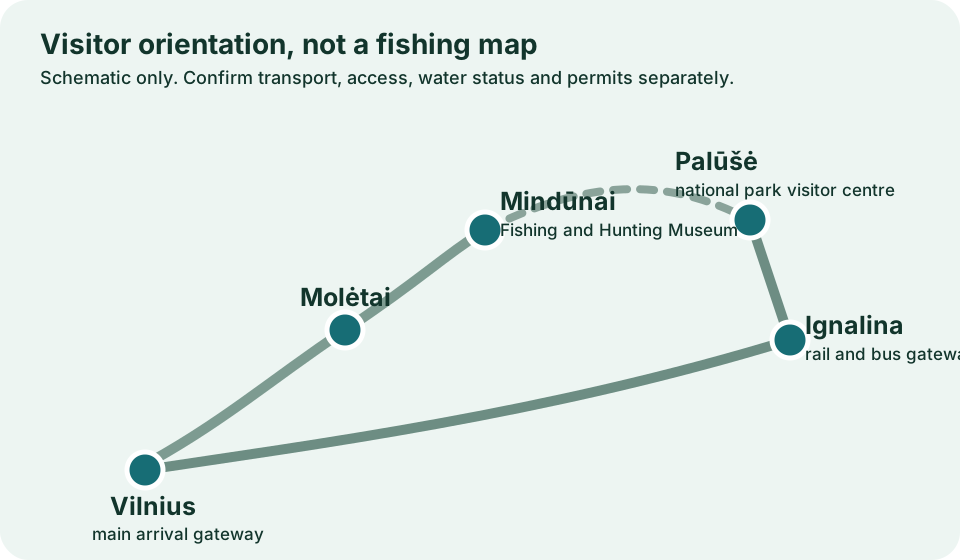
Aukštaitija National Park protects an interconnected lake-and-river system around Palūšė, Ginučiai, Tauragnai and surrounding villages. Labanoras Regional Park lies closer to Molėtai and protects the Labanoras Forest with lakes including Aisetas, Kertuojai, Lakajai, Rašia and Stirniai. The official protected-area service records 41 fish species in Aukštaitija National Park and 40 in Labanoras Regional Park. Those figures describe biological diversity, not a list of fish that visitors may legally target or retain.
Which area should you choose?
Palūšė and Aukštaitija National Park
Choose this area when you want a recognised national-park base, canoe and walking options, connected lakes and a trip that can include Ignalina. Palūšė is a practical orientation point, but many waterside stays are outside the village.
Lithuania Travel also identifies Palūšė with winter ice fishing. Treat that as a reason to consider a flexible winter stay, not as a guarantee of safe ice. The dedicated winter fishing guide explains local assessment, rescue equipment, cold-season fish rules and year-round accommodation questions.
Mindūnai and the Molėtai-Labanoras side
Choose this side when Labanoras Forest is the main landscape and you want to combine fishing with the Mindūnai Fishing and Hunting Museum and observation tower. It is also more convenient for a short trip from Vilnius than the far north-east of the national park.
A remote sodyba
A rural homestead can be the best fishing base when its shore and boat arrangements are real. It can also be frustrating when “lake access” means a steep path, a shared jetty far from the room or swimming access without fishing permission. Ask for current photographs of the launch, shore, boat and path.
Compare Aukštaitija accommodation
What fishing experience to expect
This is varied lake fishing rather than a guaranteed trophy trip. The water differs greatly between shallow, vegetated lakes and deep glacial lakes. Pike, perch and cyprinid fishing are widely associated with Lithuanian lakes, while some deep waters support species with their own restrictions and conservation importance.
Use the fish species and limits guide to translate the main Lithuanian fish names and check the ordinary retention rules. A deep lake's whitefish or vendace conditions and a conservation lake's predator rules still need a water-specific check.
Do not select a lake from a general species list. Ask a guide or host three separate questions:
- Is the species present in this water?
- Is it legal to target and retain on my date?
- Which permit and access point apply to this exact water?
Labanoras deserves its own stay
The regional park has campsites, marked trails and protected reserves; camp only at established campsites. For a short walk, the Labanoro giria nature trail is about 2.6 km. The route around Lake Alnis is a marked circular route of about 12 km, with a recommended start at the campsite at the lake’s eastern end. These routes do not give access to every reserve: respect reserve boundaries, signs and seasonal closures. Use the park visitor information and park directorate’s advice for the particular reserve, rather than treating a general park description as permission to enter.
For anglers, that means the quietest-looking shoreline is not automatically an appropriate access route. Use a formal campsite, public access, a host's documented access or a guide's legal launch point.
The park also preserves natural fish migration routes and spawning grounds. Avoid shallow spawning areas, nesting birds and vegetation even where a fishing method is technically permitted.
The Mindūnai fishing museum
The Mindūnai Fishing and Hunting Museum gives the trip cultural depth. Its lake-fishing exhibition presents equipment used in eastern Lithuania in the nineteenth century, an authentic fisherman's hut, a smokehouse and a four-metre boat recovered from Lake Peršokšnai and dated to the fifteenth century.
This is especially useful on a family trip or a poor-weather day. Check current opening hours with the museum or Molėtai tourism information before travel.
A practical three-day plan
Day 1: arrive and verify
Reach the property in daylight. Walk the shore and confirm where fishing, launching and parking are permitted. Check the boat, lifejackets and permit before preparing tackle.
Day 2: lake morning and regional afternoon
Fish early with the host or a guide. In the afternoon choose the Mindūnai museum, observation tower, a marked walk or a village route. This avoids turning an unfamiliar lake into an exhausting all-day session.
Day 3: second water or family day
Use a second lake only when its permission and access have been confirmed. Otherwise stay on the known water and change technique, or give the day to canoeing, walking and a sauna.
Getting there
A car is strongly useful, but the two sides of the region have different public-transport gateways.
Palūšė through Ignalina
LTG Link operates the Vilnius-Ignalina rail route and advises passengers to check the live search because annual timetables do not include every temporary change. Ignalina's official tourism page lists the railway and bus stations together with local transfer contacts.
For a no-car trip, arrive in Ignalina during daylight and arrange collection from the station. Palūšė is the most practical park base when the accommodation, visitor centre and water activities are meant to form one stay. A room in Ignalina is a sensible first or final night when a late train does not connect with the host.
Mindūnai through Molėtai
Use a coach or other road transport to Molėtai. Continue from Molėtai bus station only after the host has confirmed the local bus or collection. Rural services can be sparse, especially at weekends, and are not designed around a fisherman's early start.
The most reliable no-car arrangement is a property that collects guests from Molėtai and provides fishing, a boat or guide transport from the same base.
Driving
Driving gives access to more lakes and rural stays, but it does not create a right to cross private land or launch from an informal track. Ask for the approved parking and launch point. Confirm road conditions when the final approach is gravel, especially after heavy rain.
Read the Lithuania transport guide
Detailed fishing accommodation and transport planner
Where to stay
The official Ignalina and Molėtai tourism directories list apartments, hotels, rural homesteads, campgrounds and other short-stay options. Before booking, establish which fishing water, access and boat arrangements are included, if any.
Palūšė village
Best for first-time visitors, families and a mixed park holiday. Check whether the property is on Lake Lūšiai, merely near it, or uses another water. Ask for the walking distance to the actual legal fishing place and whether a boat is operated by the host or another business.
Ignalina town
Best for rail access, shops and a simple arrival. It can work for fishing when a guide collects guests, but it is not a substitute for a waterside base when independent dawn sessions are the priority.
Ginučiai, Meironys and remote park villages
Best for quiet scenery and direct immersion in the national park. These stays need stronger preparation: food supply, transfer, mobile coverage, boat arrangements and the exact fishing water should all be confirmed before booking.
Molėtai and Mindūnai
Molėtai provides the easier town base. Mindūnai places visitors closer to the Fishing and Hunting Museum, observation tower and Labanoras lakes. A stay described as “Mindūnai area” may still be outside walking distance, so request a map pin.
Campsites and homesteads
For a campsite, confirm season, drinking water, toilets, vehicle access, fire rules and whether equipment can be secured. For a homestead, ask whether the host lives on site, whether other groups share the shore, and whether quiet hours conflict with an early departure.
The deciding questions are simple: which water, which permit, which shore, which boat and how will you reach it with your equipment?
Booking checklist
- Exact lake name and location, not only “Aukštaitija” or “Labanoras”.
- Water status and required permit.
- Legal shore access and launch point.
- Boat type, engine policy and lifejacket sizes.
- Distance and surface from parking to the water.
- Secure equipment storage.
- Kitchen, cleaning area and the property's rules for preparing legally retained fish.
- Wet-weather and non-fishing activities.
- Host's working languages.
- Collection point, time and price from Ignalina or Molėtai.
- Food availability after a late arrival and before an early start.
- Whether the listed shore distance follows a usable path rather than a straight line on a map.
Official sources
- Aukštaitija National Park
- Labanoras Regional Park
- Mindūnai Fishing and Hunting Museum
- AAD fishing permit guide
- Ignalina transport information
- Ignalina accommodation directory
- Molėtai accommodation directory
- LTG Link train tickets (partner booking site)
Fish photograph catalogue
Licensed reference photographs for identification and trip planning. A photograph does not show that a species may legally be targeted, retained, transported or used as bait; check the current rule beside the relevant written guidance.


